
It's easy to get caught up in the idea that clinging to what has always worked is the safest route. But when it comes to content marketing trends, sticking to the old ways can hold you back from reaching new heights. What worked yesterday might be irrelevant tomorrow. And 2025 is the year to leave them behind to make room for smarter, more innovative approaches.
Not sure if your current approach is still hitting the mark? Don’t worry, you are not alone. We will walk through the trends that are better off left behind and help you see where your efforts might need a refresh. By the end, you will have a clearer idea of keeping your content relevant and your audience coming back for more. Let’s get started.
What’s Inside:
- The Growth of Content Marketing in Australia
- The Consequences of Clinging to Outdated Content Marketing Trends
- Content Marketing Trends to Leave Behind in 2025
- Be the Brand That Sets New Standards
The Growth of Content Marketing in Australia
If you are running a business in Australia or simply keeping an eye on trends, you might have noticed a clear and steady rise in content marketing activity over the past few years. But what exactly is behind this growth, and why should you care as a business owner or marketer in Australia?
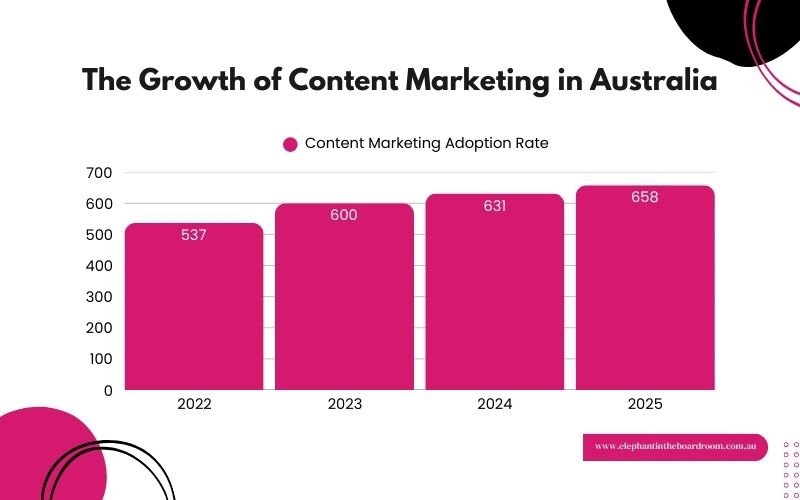
In 2022, Australia saw around 537 businesses actively embracing content marketing. Fast forward to 2023, and that number jumped to 600, showing a strong increase. By 2024, it had reached 631, and projections for 2025 show the figure climbing to 658 businesses. This steady uptick in numbers clearly indicates that Australian companies recognise the undeniable power of content to engage audiences and deliver results.
The growth of content marketing in Australia is driven by the increasing demand for valuable, engaging, and informative content from consumers. With digital platforms dominating, you can connect with your audience more authentically and cost-effectively. Embracing content marketing trends helps you build trust, increase brand visibility, and drive long-term growth.
The Consequences of Clinging to Outdated Content Marketing Trends
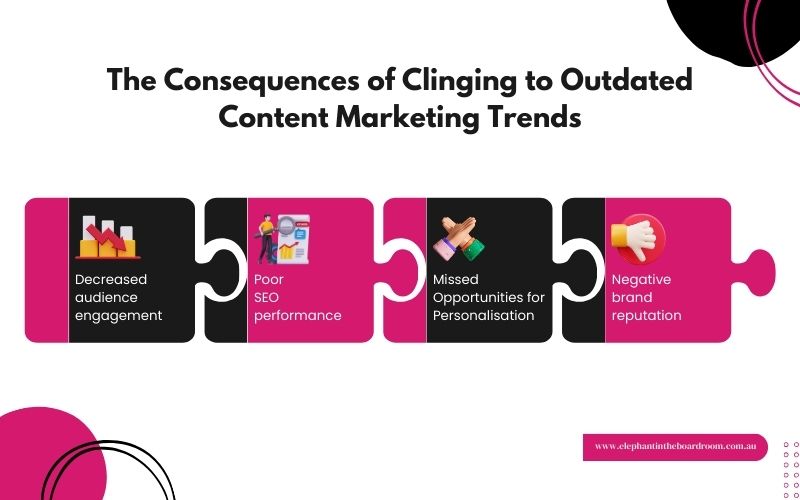
Sticking to outdated content marketing trends can seriously hinder your business's growth. Here are the consequences of clinging to outdated content marketing trends:
Decreased Audience Engagement
Your audience’s expectations change over time. If you are still focusing on long-form blog posts or overly promotional content that doesn’t resonate with today’s demands for value-driven, interactive experiences, you risk losing their attention.
Poor SEO Performance
Search engine algorithms are constantly evolving to favour high-quality, relevant content. If you are sticking to keyword stuffing, outdated SEO tactics, or neglecting mobile-first design, your content will likely fall behind in search rankings.
Missed Opportunities for Personalisation
Relying on a one-size-fits-all strategy means you are missing the chance to leverage data and tools that enable personalisation. Today’s technology allows for highly targeted content that speaks directly to the interests of individual users.
Negative Brand Reputation
Consumers value brands that stay relevant, and seeing that your content is stuck in the past can make your company look out of touch. In a competitive digital market, staying relevant means staying updated.
Content Marketing Trends to Leave Behind in 2025
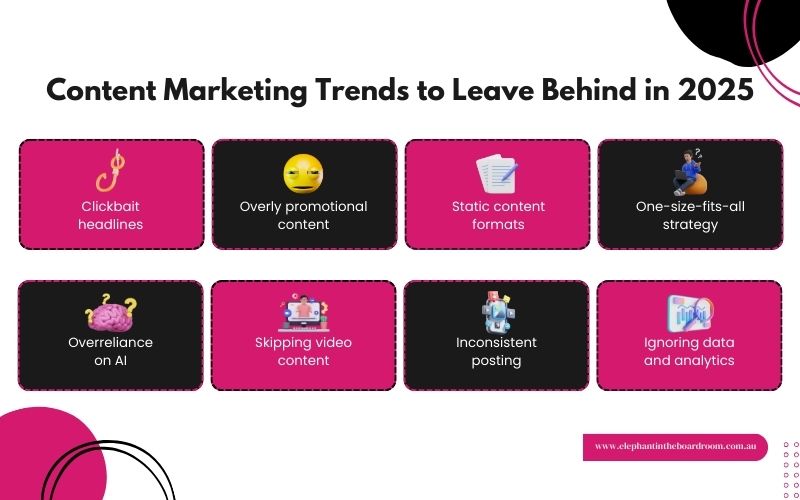
In 2025, certain trends are no longer effective, and holding on to them could hold back your growth. Here are the content marketing trends you should leave behind to ensure your strategy remains fresh and impactful:
Clickbait Headlines
While clickbait might have worked in the past to grab attention, it often leads to disappointment to readers when the content doesn't deliver. This strategy can harm your brand’s credibility and trust. This year, focus on creating compelling, honest headlines that give readers a clear idea of what they can expect.
Overly Promotional Content
Audiences today crave value, not constant sales pitches. Overly promotional content not only turns people off but can also hinder your engagement rates. Instead, focus on providing insights, solutions, and stories that naturally tie back to your products or services.
Static Content Formats
Static blog posts or simple text-based content are no longer enough. Interactive content like quizzes, polls, or calculators has been shown to increase engagement by up to 30%. People crave more dynamic experiences that allow them to engage, learn, and connect with your brand in meaningful ways.
One-Size-Fits-All Strategy
The cookie-cutter approach is no longer enough. Your audience is diverse, and each segment has different needs. Align your messaging, content, and offers to specific audience segments for more meaningful engagement.
Overreliance on AI
While AI tools can streamline processes, relying too heavily on them can lead to generic content that lacks a human touch. Balance AI assistance with authentic storytelling and creativity to maintain a genuine connection with your audience.
Skipping Video Content
Video continues to dominate as a preferred format for consuming information. Avoid neglecting this medium; instead, integrate video into your strategy to capture attention and convey messages more effectively.
Inconsistent Posting
Posting occasionally can make your brand appear disorganised or unreliable. Make sure you have a content calendar and stick to a regular posting schedule. Quality content posted consistently will keep your audience coming back for more.
Ignoring Data and Analytics
Data is king. Ignoring analytics in favour of gut feeling or trends can lead to missed opportunities. Use data to measure your content's performance, understand your audience's preferences, and optimise your strategy for better results. The more you track, the better you can refine your approach.
Be the Brand That Sets New Standards
Don’t let 2025 be a repeat of the past. It is time to stop recycling outdated tactics and start innovating with strategies that speak directly to your audience’s needs. The content marketing landscape is changing, and only those who embrace new approaches will thrive. Now is the moment to leave behind what is no longer working and create meaningful connections that drive real results.
Don’t let your brand fall behind. Elephant in the Boardroom is ready to help you break free from the past and step boldly into the future. Reach out today and let us build a content strategy that not only stands out but positions your brand for sustained success in 2025 and beyond.
It's easy to get caught up in the idea that clinging to what has always worked is the safest route. But when it comes to content marketing trends, sticking to the old ways can hold you back from reaching new heights. What worked yesterday might be irrelevant tomorrow. And 2025 is the year to leave them behind to make room for smarter, more innovative approaches.
Not sure if your current approach is still hitting the mark? Don’t worry, you are not alone. We will walk through the trends that are better off left behind and help you see where your efforts might need a refresh. By the end, you will have a clearer idea of keeping your content relevant and your audience coming back for more. Let’s get started.
What’s Inside:
- The Growth of Content Marketing in Australia
- The Consequences of Clinging to Outdated Content Marketing Trends
- Content Marketing Trends to Leave Behind in 2025
- Be the Brand That Sets New Standards
The Growth of Content Marketing in Australia
If you are running a business in Australia or simply keeping an eye on trends, you might have noticed a clear and steady rise in content marketing activity over the past few years. But what exactly is behind this growth, and why should you care as a business owner or marketer in Australia?
In 2022, Australia saw around 537 businesses actively embracing content marketing. Fast forward to 2023, and that number jumped to 600, showing a strong increase. By 2024, it had reached 631, and projections for 2025 show the figure climbing to 658 businesses. This steady uptick in numbers clearly indicates that Australian companies recognise the undeniable power of content to engage audiences and deliver results.
The growth of content marketing in Australia is driven by the increasing demand for valuable, engaging, and informative content from consumers. With digital platforms dominating, you can connect with your audience more authentically and cost-effectively. Embracing content marketing trends helps you build trust, increase brand visibility, and drive long-term growth.
The Consequences of Clinging to Outdated Content Marketing Trends
Sticking to outdated content marketing trends can seriously hinder your business's growth. Here are the consequences of clinging to outdated content marketing trends:
Decreased Audience Engagement
Your audience’s expectations change over time. If you are still focusing on long-form blog posts or overly promotional content that doesn’t resonate with today’s demands for value-driven, interactive experiences, you risk losing their attention.
Poor SEO Performance
Search engine algorithms are constantly evolving to favour high-quality, relevant content. If you are sticking to keyword stuffing, outdated SEO tactics, or neglecting mobile-first design, your content will likely fall behind in search rankings.
Missed Opportunities for Personalisation
Relying on a one-size-fits-all strategy means you are missing the chance to leverage data and tools that enable personalisation. Today’s technology allows for highly targeted content that speaks directly to the interests of individual users.
Negative Brand Reputation
Consumers value brands that stay relevant, and seeing that your content is stuck in the past can make your company look out of touch. In a competitive digital market, staying relevant means staying updated.
Content Marketing Trends to Leave Behind in 2025
In 2025, certain trends are no longer effective, and holding on to them could hold back your growth. Here are the content marketing trends you should leave behind to ensure your strategy remains fresh and impactful:
Clickbait Headlines
While clickbait might have worked in the past to grab attention, it often leads to disappointment to readers when the content doesn't deliver. This strategy can harm your brand’s credibility and trust. This year, focus on creating compelling, honest headlines that give readers a clear idea of what they can expect.
Overly Promotional Content
Audiences today crave value, not constant sales pitches. Overly promotional content not only turns people off but can also hinder your engagement rates. Instead, focus on providing insights, solutions, and stories that naturally tie back to your products or services.
Static Content Formats
Static blog posts or simple text-based content are no longer enough. Interactive content like quizzes, polls, or calculators has been shown to increase engagement by up to 30%. People crave more dynamic experiences that allow them to engage, learn, and connect with your brand in meaningful ways.
One-Size-Fits-All Strategy
The cookie-cutter approach is no longer enough. Your audience is diverse, and each segment has different needs. Align your messaging, content, and offers to specific audience segments for more meaningful engagement.
Overreliance on AI
While AI tools can streamline processes, relying too heavily on them can lead to generic content that lacks a human touch. Balance AI assistance with authentic storytelling and creativity to maintain a genuine connection with your audience.
Skipping Video Content
Video continues to dominate as a preferred format for consuming information. Avoid neglecting this medium; instead, integrate video into your strategy to capture attention and convey messages more effectively.
Inconsistent Posting
Posting occasionally can make your brand appear disorganised or unreliable. Make sure you have a content calendar and stick to a regular posting schedule. Quality content posted consistently will keep your audience coming back for more.
Ignoring Data and Analytics
Data is king. Ignoring analytics in favour of gut feeling or trends can lead to missed opportunities. Use data to measure your content's performance, understand your audience's preferences, and optimise your strategy for better results. The more you track, the better you can refine your approach.
Be the Brand That Sets New Standards
Don’t let 2025 be a repeat of the past. It is time to stop recycling outdated tactics and start innovating with strategies that speak directly to your audience’s needs. The content marketing landscape is changing, and only those who embrace new approaches will thrive. Now is the moment to leave behind what is no longer working and create meaningful connections that drive real results.
Don’t let your brand fall behind. Elephant in the Boardroom is ready to help you break free from the past and step boldly into the future. Reach out today and let us build a content strategy that not only stands out but positions your brand for sustained success in 2025 and beyond.
When you drive a high-performance car, every part of the engine must work in harmony for maximum speed and efficiency. The same principle applies to your website, each technical element must be finely tuned to ensure optimal performance. Just as a car’s performance is determined by its engine, exhaust, and fuel system, your website's success depends on its technical SEO. If one part is underperforming, the whole system suffers. Understanding how technical SEO impacts organic traffic is essential to boosting your site’s visibility and ranking on search engines.
Getting technical SEO right means your site is ready to perform at its best, attracting the right traffic, engaging users, and achieving long-term growth. Now, let us dive deeper into how this works. Ready to optimise your website’s performance? Keep reading to discover how Technical SEO impacts Organic Traffic and why it matters more than ever.
What’s Inside:
- Technical SEO vs. On-Page SEO vs. Off-Page SEO
- Understanding Technical SEO Strategies
- How Technical SEO Impacts Organic Traffic?
- Technical SEO Best Practices to Increase Organic Traffic for Websites
- Technical SEO Impacts Organic Traffic: Drive More Visitors
Technical SEO vs. On-Page SEO vs. Off-Page SEO
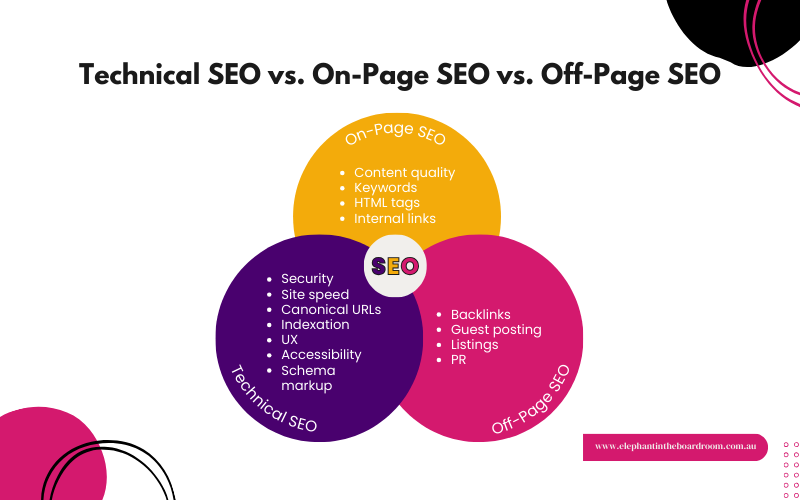
When optimising a website, there are three core pillars of SEO to focus on: technical SEO, on-page SEO, and off-page SEO. Each tackles a different aspect of how search engines engage with your site. Technical SEO is all about the behind-the-scenes infrastructure. It ensures that search engines can efficiently crawl, interpret, and index your website.
On-page SEO, in contrast, focuses on the visible elements of your site, the content, and the structure that users interact with. Meanwhile, off-page SEO is about building your site’s authority and reputation through external efforts, with backlinks playing a central role. By balancing these three pillars, you can create a comprehensive SEO strategy for business that enhances your site’s visibility, authority, and user engagement.
Understanding Technical SEO Strategies
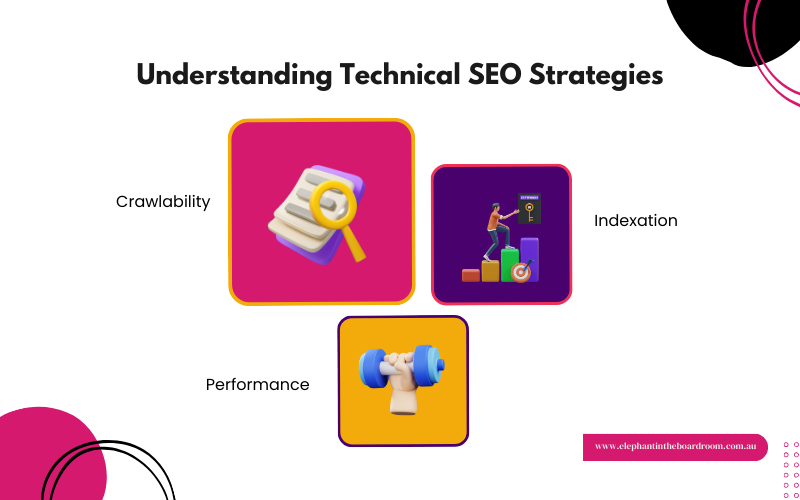
Here’s a detailed look at the key strategies involved in technical SEO. Understanding these concepts is the first step towards optimising your online presence effectively.
Crawlability
Crawlability refers to how easily search engines can access and navigate your website. Key factors include:
- Crawl budget- Understand how search engines allocate their resources to crawl your site. Optimising your site structure can help maximise this budget.
- JavaScript management- Ensure that any JavaScript used on your site does not hinder search engines from accessing content.
- Redirects and server errors- Regularly check for broken links and server errors, and fix them promptly to maintain a healthy crawl path.
Performance
Website performance significantly influences user experience and SEO rankings. Focus on:
- Site Speed- Optimise loading times, aiming for under 2.5 seconds for the largest contentful paint (LCP) to enhance user satisfaction.
- Code bloat- Minimise unnecessary code that can slow down your site.
- Responsive design - Ensure your site is mobile-friendly and developed with responsive web design, adapting seamlessly across devices.
Indexation
For your pages to rank well, they must be indexed correctly. Consider the following:
- Sitemaps- Create and submit XML sitemaps to make it easier for search engines to find all your pages.
- Logfile analysis- Regularly check server log files to understand how search engines are interacting with your site
How Technical SEO Impacts Organic Traffic?
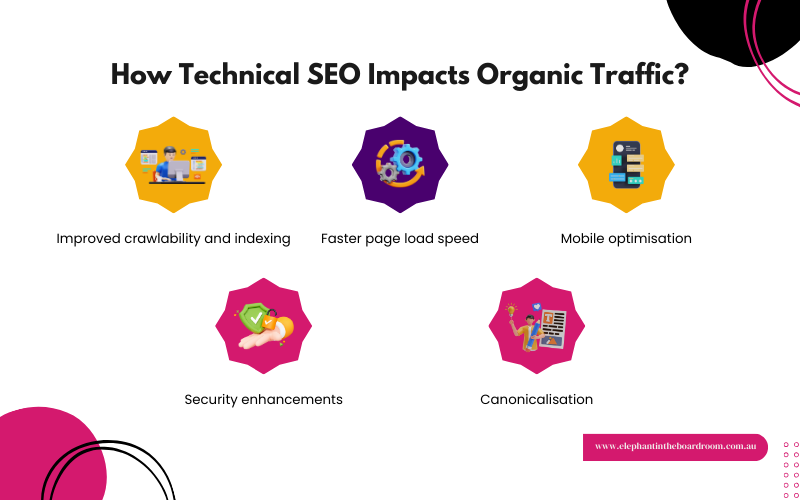
While content quality and backlinks often take the spotlight, technical SEO serves as the foundation upon which your site's visibility depends. Without proper technical SEO, even the best content may fail to reach its full potential.
Here’s how technical SEO impacts organic traffic:
Improved Crawlability and Indexing
Technical SEO ensures that search engines can easily access and understand your site. This includes fixing crawl errors, improving site structure, and ensuring secure HTTPS protocols.
Faster Page Load Speed
A lightning-fast website not only improves user experience but also gets a boost in search rankings. Nobody enjoys waiting for a slow page to load, and neither do search engines.
Mobile Optimisation
Technical SEO helps ensure that your website is responsive and provides a seamless experience across all devices, boosting your chances of improving ranking higher in search results.
Security Enhancements
Implementing security measures like HTTPS not only protects user data but also positively influences rankings. Search engines prioritise secure sites, which can lead to improved organic traffic
Canonicalisation
Technical SEO helps manage duplicate content issues through proper canonical tags. Duplicate content can confuse search engines and dilute ranking potential.
Technical SEO Best Practices to Increase Organic Traffic for Websites
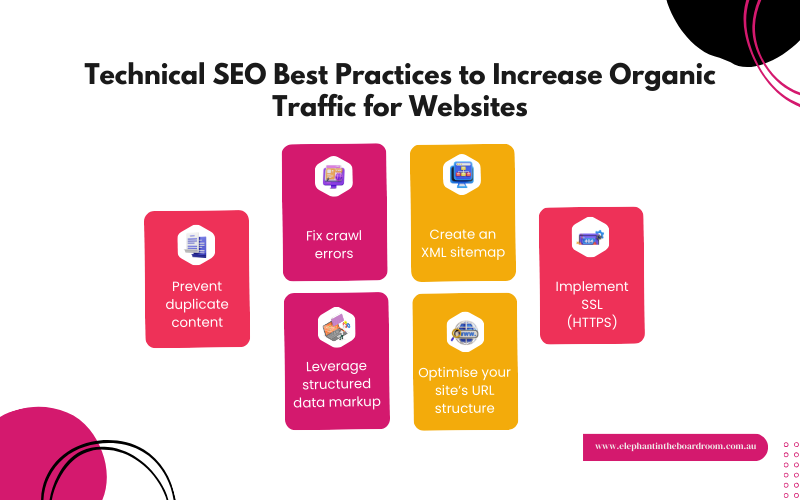
Technical SEO can feel overwhelming, but it is one of the most rewarding aspects of optimising your site. By following these practices, you are not just helping search engines understand your site better, you are also enhancing the experience for your visitors.
Implement SSL (HTTPS)
Installing an SSL certificate ensures your site is secure, enhances user trust, and provides a ranking boost, particularly important for e-commerce and data-sensitive websites.
Fix Crawl Errors
Regularly do a website audit for identifying crawling errors using Google Search Console. These errors can prevent search engines from accessing critical pages.
Leverage Structured Data Markup (Schema)
Implement structured data (schema markup) to provide search engines with more context about your content.
Create an XML Sitemap
An XML sitemap helps search engines understand the structure of your site and find new or updated pages quickly. Regularly update and submit your sitemap through tools like Google Search Console.
Optimise Your Site’s URL Structure
Ensure your URLs are clean, descriptive, and SEO-friendly. Shorter URLs with relevant keywords improve both user experience and search engine rankings. Avoid using excessive parameters or unnecessary words.
Prevent Duplicate Content Issues
Duplicate content can dilute ranking signals, but using canonical tags helps search engines understand which version to prioritise.
Technical SEO Impacts Organic Traffic: Drive More Visitors
Technical SEO impacts organic traffic, which is why mastering technical SEO is the key to unlocking higher organic traffic and standing out in search engine results. It is not just about driving more traffic; it is about attracting the right visitors who are genuinely interested in what you offer. So, don’t wait any longer; make technical SEO a priority and watch your website soar.
Feeling overwhelmed? No problem. You don’t have to go it alone. Let us be your guide through the technical SEO landscape, helping you supercharge your organic reach and achieve the results you are after. Get in touch with us today, and let us craft a strategy that drives real impact for your site.
When you drive a high-performance car, every part of the engine must work in harmony for maximum speed and efficiency. The same principle applies to your website, each technical element must be finely tuned to ensure optimal performance. Just as a car’s performance is determined by its engine, exhaust, and fuel system, your website's success depends on its technical SEO. If one part is underperforming, the whole system suffers. Understanding how technical SEO impacts organic traffic is essential to boosting your site’s visibility and ranking on search engines.
Getting technical SEO right means your site is ready to perform at its best, attracting the right traffic, engaging users, and achieving long-term growth. Now, let us dive deeper into how this works. Ready to optimise your website’s performance? Keep reading to discover how Technical SEO impacts Organic Traffic and why it matters more than ever.
What’s Inside:
- Technical SEO vs. On-Page SEO vs. Off-Page SEO
- Understanding Technical SEO Strategies
- How Technical SEO Impacts Organic Traffic?
- Technical SEO Best Practices to Increase Organic Traffic for Websites
- Technical SEO Impacts Organic Traffic: Drive More Visitors
Technical SEO vs. On-Page SEO vs. Off-Page SEO
When optimising a website, there are three core pillars of SEO to focus on: technical SEO, on-page SEO, and off-page SEO. Each tackles a different aspect of how search engines engage with your site. Technical SEO is all about the behind-the-scenes infrastructure. It ensures that search engines can efficiently crawl, interpret, and index your website.
On-page SEO, in contrast, focuses on the visible elements of your site, the content, and the structure that users interact with. Meanwhile, off-page SEO is about building your site’s authority and reputation through external efforts, with backlinks playing a central role. By balancing these three pillars, you can create a comprehensive SEO strategy for business that enhances your site’s visibility, authority, and user engagement.
Understanding Technical SEO Strategies
Here’s a detailed look at the key strategies involved in technical SEO. Understanding these concepts is the first step towards optimising your online presence effectively.
Crawlability
Crawlability refers to how easily search engines can access and navigate your website. Key factors include:
- Crawl budget- Understand how search engines allocate their resources to crawl your site. Optimising your site structure can help maximise this budget.
- JavaScript management- Ensure that any JavaScript used on your site does not hinder search engines from accessing content.
- Redirects and server errors- Regularly check for broken links and server errors, and fix them promptly to maintain a healthy crawl path.
Performance
Website performance significantly influences user experience and SEO rankings. Focus on:
- Site Speed- Optimise loading times, aiming for under 2.5 seconds for the largest contentful paint (LCP) to enhance user satisfaction.
- Code bloat- Minimise unnecessary code that can slow down your site.
- Responsive design - Ensure your site is mobile-friendly and developed with responsive web design, adapting seamlessly across devices.
Indexation
For your pages to rank well, they must be indexed correctly. Consider the following:
- Sitemaps- Create and submit XML sitemaps to make it easier for search engines to find all your pages.
- Logfile analysis- Regularly check server log files to understand how search engines are interacting with your site
How Technical SEO Impacts Organic Traffic?
While content quality and backlinks often take the spotlight, technical SEO serves as the foundation upon which your site's visibility depends. Without proper technical SEO, even the best content may fail to reach its full potential.
Here’s how technical SEO impacts organic traffic:
Improved Crawlability and Indexing
Technical SEO ensures that search engines can easily access and understand your site. This includes fixing crawl errors, improving site structure, and ensuring secure HTTPS protocols.
Faster Page Load Speed
A lightning-fast website not only improves user experience but also gets a boost in search rankings. Nobody enjoys waiting for a slow page to load, and neither do search engines.
Mobile Optimisation
Technical SEO helps ensure that your website is responsive and provides a seamless experience across all devices, boosting your chances of improving ranking higher in search results.
Security Enhancements
Implementing security measures like HTTPS not only protects user data but also positively influences rankings. Search engines prioritise secure sites, which can lead to improved organic traffic
Canonicalisation
Technical SEO helps manage duplicate content issues through proper canonical tags. Duplicate content can confuse search engines and dilute ranking potential.
Technical SEO Best Practices to Increase Organic Traffic for Websites
Technical SEO can feel overwhelming, but it is one of the most rewarding aspects of optimising your site. By following these practices, you are not just helping search engines understand your site better, you are also enhancing the experience for your visitors.
Implement SSL (HTTPS)
Installing an SSL certificate ensures your site is secure, enhances user trust, and provides a ranking boost, particularly important for e-commerce and data-sensitive websites.
Fix Crawl Errors
Regularly do a website audit for identifying crawling errors using Google Search Console. These errors can prevent search engines from accessing critical pages.
Leverage Structured Data Markup (Schema)
Implement structured data (schema markup) to provide search engines with more context about your content.
Create an XML Sitemap
An XML sitemap helps search engines understand the structure of your site and find new or updated pages quickly. Regularly update and submit your sitemap through tools like Google Search Console.
Optimise Your Site’s URL Structure
Ensure your URLs are clean, descriptive, and SEO-friendly. Shorter URLs with relevant keywords improve both user experience and search engine rankings. Avoid using excessive parameters or unnecessary words.
Prevent Duplicate Content Issues
Duplicate content can dilute ranking signals, but using canonical tags helps search engines understand which version to prioritise.
Technical SEO Impacts Organic Traffic: Drive More Visitors
Technical SEO impacts organic traffic, which is why mastering technical SEO is the key to unlocking higher organic traffic and standing out in search engine results. It is not just about driving more traffic; it is about attracting the right visitors who are genuinely interested in what you offer. So, don’t wait any longer; make technical SEO a priority and watch your website soar.
Feeling overwhelmed? No problem. You don’t have to go it alone. Let us be your guide through the technical SEO landscape, helping you supercharge your organic reach and achieve the results you are after. Get in touch with us today, and let us craft a strategy that drives real impact for your site.
When you drive a high-performance car, every part of the engine must work in harmony for maximum speed and efficiency. The same principle applies to your website, each technical element must be finely tuned to ensure optimal performance. Just as a car’s performance is determined by its engine, exhaust, and fuel system, your website's success depends on its technical SEO. If one part is underperforming, the whole system suffers. Understanding how technical SEO impacts organic traffic is essential to boosting your site’s visibility and ranking on search engines.
Getting technical SEO right means your site is ready to perform at its best, attracting the right traffic, engaging users, and achieving long-term growth. Now, let us dive deeper into how this works. Ready to optimise your website’s performance? Keep reading to discover how Technical SEO impacts Organic Traffic and why it matters more than ever.
What’s Inside:
- Technical SEO vs. On-Page SEO vs. Off-Page SEO
- Understanding Technical SEO Strategies
- How Technical SEO Impacts Organic Traffic?
- Technical SEO Best Practices to Increase Organic Traffic for Websites
- Technical SEO Impacts Organic Traffic: Drive More Visitors
Technical SEO vs. On-Page SEO vs. Off-Page SEO
When optimising a website, there are three core pillars of SEO to focus on: technical SEO, on-page SEO, and off-page SEO. Each tackles a different aspect of how search engines engage with your site. Technical SEO is all about the behind-the-scenes infrastructure. It ensures that search engines can efficiently crawl, interpret, and index your website.
On-page SEO, in contrast, focuses on the visible elements of your site, the content, and the structure that users interact with. Meanwhile, off-page SEO is about building your site’s authority and reputation through external efforts, with backlinks playing a central role. By balancing these three pillars, you can create a comprehensive SEO strategy for business that enhances your site’s visibility, authority, and user engagement.
Understanding Technical SEO Strategies
Here’s a detailed look at the key strategies involved in technical SEO. Understanding these concepts is the first step towards optimising your online presence effectively.
Crawlability
Crawlability refers to how easily search engines can access and navigate your website. Key factors include:
- Crawl budget- Understand how search engines allocate their resources to crawl your site. Optimising your site structure can help maximise this budget.
- JavaScript management- Ensure that any JavaScript used on your site does not hinder search engines from accessing content.
- Redirects and server errors- Regularly check for broken links and server errors, and fix them promptly to maintain a healthy crawl path.
Performance
Website performance significantly influences user experience and SEO rankings. Focus on:
- Site Speed- Optimise loading times, aiming for under 2.5 seconds for the largest contentful paint (LCP) to enhance user satisfaction.
- Code bloat- Minimise unnecessary code that can slow down your site.
- Responsive design - Ensure your site is mobile-friendly and developed with responsive web design, adapting seamlessly across devices.
Indexation
For your pages to rank well, they must be indexed correctly. Consider the following:
- Sitemaps- Create and submit XML sitemaps to make it easier for search engines to find all your pages.
- Logfile analysis- Regularly check server log files to understand how search engines are interacting with your site
How Technical SEO Impacts Organic Traffic?
While content quality and backlinks often take the spotlight, technical SEO serves as the foundation upon which your site's visibility depends. Without proper technical SEO, even the best content may fail to reach its full potential.
Here’s how technical SEO impacts organic traffic:
Improved Crawlability and Indexing
Technical SEO ensures that search engines can easily access and understand your site. This includes fixing crawl errors, improving site structure, and ensuring secure HTTPS protocols.
Faster Page Load Speed
A lightning-fast website not only improves user experience but also gets a boost in search rankings. Nobody enjoys waiting for a slow page to load, and neither do search engines.
Mobile Optimisation
Technical SEO helps ensure that your website is responsive and provides a seamless experience across all devices, boosting your chances of improving ranking higher in search results.
Security Enhancements
Implementing security measures like HTTPS not only protects user data but also positively influences rankings. Search engines prioritise secure sites, which can lead to improved organic traffic
Canonicalisation
Technical SEO helps manage duplicate content issues through proper canonical tags. Duplicate content can confuse search engines and dilute ranking potential.
Technical SEO Best Practices to Increase Organic Traffic for Websites
Technical SEO can feel overwhelming, but it is one of the most rewarding aspects of optimising your site. By following these practices, you are not just helping search engines understand your site better, you are also enhancing the experience for your visitors.
Implement SSL (HTTPS)
Installing an SSL certificate ensures your site is secure, enhances user trust, and provides a ranking boost, particularly important for e-commerce and data-sensitive websites.
Fix Crawl Errors
Regularly do a website audit for identifying crawling errors using Google Search Console. These errors can prevent search engines from accessing critical pages.
Leverage Structured Data Markup (Schema)
Implement structured data (schema markup) to provide search engines with more context about your content.
Create an XML Sitemap
An XML sitemap helps search engines understand the structure of your site and find new or updated pages quickly. Regularly update and submit your sitemap through tools like Google Search Console.
Optimise Your Site’s URL Structure
Ensure your URLs are clean, descriptive, and SEO-friendly. Shorter URLs with relevant keywords improve both user experience and search engine rankings. Avoid using excessive parameters or unnecessary words.
Prevent Duplicate Content Issues
Duplicate content can dilute ranking signals, but using canonical tags helps search engines understand which version to prioritise.
Technical SEO Impacts Organic Traffic: Drive More Visitors
Technical SEO impacts organic traffic, which is why mastering technical SEO is the key to unlocking higher organic traffic and standing out in search engine results. It is not just about driving more traffic; it is about attracting the right visitors who are genuinely interested in what you offer. So, don’t wait any longer; make technical SEO a priority and watch your website soar.
Feeling overwhelmed? No problem. You don’t have to go it alone. Let us be your guide through the technical SEO landscape, helping you supercharge your organic reach and achieve the results you are after. Get in touch with us today, and let us craft a strategy that drives real impact for your site.
When you drive a high-performance car, every part of the engine must work in harmony for maximum speed and efficiency. The same principle applies to your website, each technical element must be finely tuned to ensure optimal performance. Just as a car’s performance is determined by its engine, exhaust, and fuel system, your website's success depends on its technical SEO. If one part is underperforming, the whole system suffers. Understanding how technical SEO impacts organic traffic is essential to boosting your site’s visibility and ranking on search engines.
Getting technical SEO right means your site is ready to perform at its best, attracting the right traffic, engaging users, and achieving long-term growth. Now, let us dive deeper into how this works. Ready to optimise your website’s performance? Keep reading to discover how Technical SEO impacts Organic Traffic and why it matters more than ever.
What’s Inside:
- Technical SEO vs. On-Page SEO vs. Off-Page SEO
- Understanding Technical SEO Strategies
- How Technical SEO Impacts Organic Traffic?
- Technical SEO Best Practices to Increase Organic Traffic for Websites
- Technical SEO Impacts Organic Traffic: Drive More Visitors
Technical SEO vs. On-Page SEO vs. Off-Page SEO
When optimising a website, there are three core pillars of SEO to focus on: technical SEO, on-page SEO, and off-page SEO. Each tackles a different aspect of how search engines engage with your site. Technical SEO is all about the behind-the-scenes infrastructure. It ensures that search engines can efficiently crawl, interpret, and index your website.
On-page SEO, in contrast, focuses on the visible elements of your site, the content, and the structure that users interact with. Meanwhile, off-page SEO is about building your site’s authority and reputation through external efforts, with backlinks playing a central role. By balancing these three pillars, you can create a comprehensive SEO strategy for business that enhances your site’s visibility, authority, and user engagement.
Understanding Technical SEO Strategies
Here’s a detailed look at the key strategies involved in technical SEO. Understanding these concepts is the first step towards optimising your online presence effectively.
Crawlability
Crawlability refers to how easily search engines can access and navigate your website. Key factors include:
- Crawl budget- Understand how search engines allocate their resources to crawl your site. Optimising your site structure can help maximise this budget.
- JavaScript management- Ensure that any JavaScript used on your site does not hinder search engines from accessing content.
- Redirects and server errors- Regularly check for broken links and server errors, and fix them promptly to maintain a healthy crawl path.
Performance
Website performance significantly influences user experience and SEO rankings. Focus on:
- Site Speed- Optimise loading times, aiming for under 2.5 seconds for the largest contentful paint (LCP) to enhance user satisfaction.
- Code bloat- Minimise unnecessary code that can slow down your site.
- Responsive design - Ensure your site is mobile-friendly and developed with responsive web design, adapting seamlessly across devices.
Indexation
For your pages to rank well, they must be indexed correctly. Consider the following:
- Sitemaps- Create and submit XML sitemaps to make it easier for search engines to find all your pages.
- Logfile analysis- Regularly check server log files to understand how search engines are interacting with your site
How Technical SEO Impacts Organic Traffic?
While content quality and backlinks often take the spotlight, technical SEO serves as the foundation upon which your site's visibility depends. Without proper technical SEO, even the best content may fail to reach its full potential.
Here’s how technical SEO impacts organic traffic:
Improved Crawlability and Indexing
Technical SEO ensures that search engines can easily access and understand your site. This includes fixing crawl errors, improving site structure, and ensuring secure HTTPS protocols.
Faster Page Load Speed
A lightning-fast website not only improves user experience but also gets a boost in search rankings. Nobody enjoys waiting for a slow page to load, and neither do search engines.
Mobile Optimisation
Technical SEO helps ensure that your website is responsive and provides a seamless experience across all devices, boosting your chances of improving ranking higher in search results.
Security Enhancements
Implementing security measures like HTTPS not only protects user data but also positively influences rankings. Search engines prioritise secure sites, which can lead to improved organic traffic
Canonicalisation
Technical SEO helps manage duplicate content issues through proper canonical tags. Duplicate content can confuse search engines and dilute ranking potential.
Technical SEO Best Practices to Increase Organic Traffic for Websites
Technical SEO can feel overwhelming, but it is one of the most rewarding aspects of optimising your site. By following these practices, you are not just helping search engines understand your site better, you are also enhancing the experience for your visitors.
Implement SSL (HTTPS)
Installing an SSL certificate ensures your site is secure, enhances user trust, and provides a ranking boost, particularly important for e-commerce and data-sensitive websites.
Fix Crawl Errors
Regularly do a website audit for identifying crawling errors using Google Search Console. These errors can prevent search engines from accessing critical pages.
Leverage Structured Data Markup (Schema)
Implement structured data (schema markup) to provide search engines with more context about your content.
Create an XML Sitemap
An XML sitemap helps search engines understand the structure of your site and find new or updated pages quickly. Regularly update and submit your sitemap through tools like Google Search Console.
Optimise Your Site’s URL Structure
Ensure your URLs are clean, descriptive, and SEO-friendly. Shorter URLs with relevant keywords improve both user experience and search engine rankings. Avoid using excessive parameters or unnecessary words.
Prevent Duplicate Content Issues
Duplicate content can dilute ranking signals, but using canonical tags helps search engines understand which version to prioritise.
Technical SEO Impacts Organic Traffic: Drive More Visitors
Technical SEO impacts organic traffic, which is why mastering technical SEO is the key to unlocking higher organic traffic and standing out in search engine results. It is not just about driving more traffic; it is about attracting the right visitors who are genuinely interested in what you offer. So, don’t wait any longer; make technical SEO a priority and watch your website soar.
Feeling overwhelmed? No problem. You don’t have to go it alone. Let us be your guide through the technical SEO landscape, helping you supercharge your organic reach and achieve the results you are after. Get in touch with us today, and let us craft a strategy that drives real impact for your site.
When you drive a high-performance car, every part of the engine must work in harmony for maximum speed and efficiency. The same principle applies to your website, each technical element must be finely tuned to ensure optimal performance. Just as a car’s performance is determined by its engine, exhaust, and fuel system, your website's success depends on its technical SEO. If one part is underperforming, the whole system suffers. Understanding how technical SEO impacts organic traffic is essential to boosting your site’s visibility and ranking on search engines.
Getting technical SEO right means your site is ready to perform at its best, attracting the right traffic, engaging users, and achieving long-term growth. Now, let us dive deeper into how this works. Ready to optimise your website’s performance? Keep reading to discover how Technical SEO impacts Organic Traffic and why it matters more than ever.
What’s Inside:
- Technical SEO vs. On-Page SEO vs. Off-Page SEO
- Understanding Technical SEO Strategies
- How Technical SEO Impacts Organic Traffic?
- Technical SEO Best Practices to Increase Organic Traffic for Websites
- Technical SEO Impacts Organic Traffic: Drive More Visitors
Technical SEO vs. On-Page SEO vs. Off-Page SEO
When optimising a website, there are three core pillars of SEO to focus on: technical SEO, on-page SEO, and off-page SEO. Each tackles a different aspect of how search engines engage with your site. Technical SEO is all about the behind-the-scenes infrastructure. It ensures that search engines can efficiently crawl, interpret, and index your website.
On-page SEO, in contrast, focuses on the visible elements of your site, the content, and the structure that users interact with. Meanwhile, off-page SEO is about building your site’s authority and reputation through external efforts, with backlinks playing a central role. By balancing these three pillars, you can create a comprehensive SEO strategy for business that enhances your site’s visibility, authority, and user engagement.
Understanding Technical SEO Strategies
Here’s a detailed look at the key strategies involved in technical SEO. Understanding these concepts is the first step towards optimising your online presence effectively.
Crawlability
Crawlability refers to how easily search engines can access and navigate your website. Key factors include:
- Crawl budget- Understand how search engines allocate their resources to crawl your site. Optimising your site structure can help maximise this budget.
- JavaScript management- Ensure that any JavaScript used on your site does not hinder search engines from accessing content.
- Redirects and server errors- Regularly check for broken links and server errors, and fix them promptly to maintain a healthy crawl path.
Performance
Website performance significantly influences user experience and SEO rankings. Focus on:
- Site Speed- Optimise loading times, aiming for under 2.5 seconds for the largest contentful paint (LCP) to enhance user satisfaction.
- Code bloat- Minimise unnecessary code that can slow down your site.
- Responsive design - Ensure your site is mobile-friendly and developed with responsive web design, adapting seamlessly across devices.
Indexation
For your pages to rank well, they must be indexed correctly. Consider the following:
- Sitemaps- Create and submit XML sitemaps to make it easier for search engines to find all your pages.
- Logfile analysis- Regularly check server log files to understand how search engines are interacting with your site
How Technical SEO Impacts Organic Traffic?
While content quality and backlinks often take the spotlight, technical SEO serves as the foundation upon which your site's visibility depends. Without proper technical SEO, even the best content may fail to reach its full potential.
Here’s how technical SEO impacts organic traffic:
Improved Crawlability and Indexing
Technical SEO ensures that search engines can easily access and understand your site. This includes fixing crawl errors, improving site structure, and ensuring secure HTTPS protocols.
Faster Page Load Speed
A lightning-fast website not only improves user experience but also gets a boost in search rankings. Nobody enjoys waiting for a slow page to load, and neither do search engines.
Mobile Optimisation
Technical SEO helps ensure that your website is responsive and provides a seamless experience across all devices, boosting your chances of improving ranking higher in search results.
Security Enhancements
Implementing security measures like HTTPS not only protects user data but also positively influences rankings. Search engines prioritise secure sites, which can lead to improved organic traffic
Canonicalisation
Technical SEO helps manage duplicate content issues through proper canonical tags. Duplicate content can confuse search engines and dilute ranking potential.
Technical SEO Best Practices to Increase Organic Traffic for Websites
Technical SEO can feel overwhelming, but it is one of the most rewarding aspects of optimising your site. By following these practices, you are not just helping search engines understand your site better, you are also enhancing the experience for your visitors.
Implement SSL (HTTPS)
Installing an SSL certificate ensures your site is secure, enhances user trust, and provides a ranking boost, particularly important for e-commerce and data-sensitive websites.
Fix Crawl Errors
Regularly do a website audit for identifying crawling errors using Google Search Console. These errors can prevent search engines from accessing critical pages.
Leverage Structured Data Markup (Schema)
Implement structured data (schema markup) to provide search engines with more context about your content.
Create an XML Sitemap
An XML sitemap helps search engines understand the structure of your site and find new or updated pages quickly. Regularly update and submit your sitemap through tools like Google Search Console.
Optimise Your Site’s URL Structure
Ensure your URLs are clean, descriptive, and SEO-friendly. Shorter URLs with relevant keywords improve both user experience and search engine rankings. Avoid using excessive parameters or unnecessary words.
Prevent Duplicate Content Issues
Duplicate content can dilute ranking signals, but using canonical tags helps search engines understand which version to prioritise.
Technical SEO Impacts Organic Traffic: Drive More Visitors
Technical SEO impacts organic traffic, which is why mastering technical SEO is the key to unlocking higher organic traffic and standing out in search engine results. It is not just about driving more traffic; it is about attracting the right visitors who are genuinely interested in what you offer. So, don’t wait any longer; make technical SEO a priority and watch your website soar.
Feeling overwhelmed? No problem. You don’t have to go it alone. Let us be your guide through the technical SEO landscape, helping you supercharge your organic reach and achieve the results you are after. Get in touch with us today, and let us craft a strategy that drives real impact for your site.
When you drive a high-performance car, every part of the engine must work in harmony for maximum speed and efficiency. The same principle applies to your website, each technical element must be finely tuned to ensure optimal performance. Just as a car’s performance is determined by its engine, exhaust, and fuel system, your website's success depends on its technical SEO. If one part is underperforming, the whole system suffers. Understanding how technical SEO impacts organic traffic is essential to boosting your site’s visibility and ranking on search engines.
Getting technical SEO right means your site is ready to perform at its best, attracting the right traffic, engaging users, and achieving long-term growth. Now, let us dive deeper into how this works. Ready to optimise your website’s performance? Keep reading to discover how Technical SEO impacts Organic Traffic and why it matters more than ever.
What’s Inside:
- Technical SEO vs. On-Page SEO vs. Off-Page SEO
- Understanding Technical SEO Strategies
- How Technical SEO Impacts Organic Traffic?
- Technical SEO Best Practices to Increase Organic Traffic for Websites
- Technical SEO Impacts Organic Traffic: Drive More Visitors
Technical SEO vs. On-Page SEO vs. Off-Page SEO
When optimising a website, there are three core pillars of SEO to focus on: technical SEO, on-page SEO, and off-page SEO. Each tackles a different aspect of how search engines engage with your site. Technical SEO is all about the behind-the-scenes infrastructure. It ensures that search engines can efficiently crawl, interpret, and index your website.
On-page SEO, in contrast, focuses on the visible elements of your site, the content, and the structure that users interact with. Meanwhile, off-page SEO is about building your site’s authority and reputation through external efforts, with backlinks playing a central role. By balancing these three pillars, you can create a comprehensive SEO strategy for business that enhances your site’s visibility, authority, and user engagement.
Understanding Technical SEO Strategies
Here’s a detailed look at the key strategies involved in technical SEO. Understanding these concepts is the first step towards optimising your online presence effectively.
Crawlability
Crawlability refers to how easily search engines can access and navigate your website. Key factors include:
- Crawl budget- Understand how search engines allocate their resources to crawl your site. Optimising your site structure can help maximise this budget.
- JavaScript management- Ensure that any JavaScript used on your site does not hinder search engines from accessing content.
- Redirects and server errors- Regularly check for broken links and server errors, and fix them promptly to maintain a healthy crawl path.
Performance
Website performance significantly influences user experience and SEO rankings. Focus on:
- Site Speed- Optimise loading times, aiming for under 2.5 seconds for the largest contentful paint (LCP) to enhance user satisfaction.
- Code bloat- Minimise unnecessary code that can slow down your site.
- Responsive design - Ensure your site is mobile-friendly and developed with responsive web design, adapting seamlessly across devices.
Indexation
For your pages to rank well, they must be indexed correctly. Consider the following:
- Sitemaps- Create and submit XML sitemaps to make it easier for search engines to find all your pages.
- Logfile analysis- Regularly check server log files to understand how search engines are interacting with your site
How Technical SEO Impacts Organic Traffic?
While content quality and backlinks often take the spotlight, technical SEO serves as the foundation upon which your site's visibility depends. Without proper technical SEO, even the best content may fail to reach its full potential.
Here’s how technical SEO impacts organic traffic:
Improved Crawlability and Indexing
Technical SEO ensures that search engines can easily access and understand your site. This includes fixing crawl errors, improving site structure, and ensuring secure HTTPS protocols.
Faster Page Load Speed
A lightning-fast website not only improves user experience but also gets a boost in search rankings. Nobody enjoys waiting for a slow page to load, and neither do search engines.
Mobile Optimisation
Technical SEO helps ensure that your website is responsive and provides a seamless experience across all devices, boosting your chances of improving ranking higher in search results.
Security Enhancements
Implementing security measures like HTTPS not only protects user data but also positively influences rankings. Search engines prioritise secure sites, which can lead to improved organic traffic
Canonicalisation
Technical SEO helps manage duplicate content issues through proper canonical tags. Duplicate content can confuse search engines and dilute ranking potential.
Technical SEO Best Practices to Increase Organic Traffic for Websites
Technical SEO can feel overwhelming, but it is one of the most rewarding aspects of optimising your site. By following these practices, you are not just helping search engines understand your site better, you are also enhancing the experience for your visitors.
Implement SSL (HTTPS)
Installing an SSL certificate ensures your site is secure, enhances user trust, and provides a ranking boost, particularly important for e-commerce and data-sensitive websites.
Fix Crawl Errors
Regularly do a website audit for identifying crawling errors using Google Search Console. These errors can prevent search engines from accessing critical pages.
Leverage Structured Data Markup (Schema)
Implement structured data (schema markup) to provide search engines with more context about your content.
Create an XML Sitemap
An XML sitemap helps search engines understand the structure of your site and find new or updated pages quickly. Regularly update and submit your sitemap through tools like Google Search Console.
Optimise Your Site’s URL Structure
Ensure your URLs are clean, descriptive, and SEO-friendly. Shorter URLs with relevant keywords improve both user experience and search engine rankings. Avoid using excessive parameters or unnecessary words.
Prevent Duplicate Content Issues
Duplicate content can dilute ranking signals, but using canonical tags helps search engines understand which version to prioritise.
Technical SEO Impacts Organic Traffic: Drive More Visitors
Technical SEO impacts organic traffic, which is why mastering technical SEO is the key to unlocking higher organic traffic and standing out in search engine results. It is not just about driving more traffic; it is about attracting the right visitors who are genuinely interested in what you offer. So, don’t wait any longer; make technical SEO a priority and watch your website soar.
Feeling overwhelmed? No problem. You don’t have to go it alone. Let us be your guide through the technical SEO landscape, helping you supercharge your organic reach and achieve the results you are after. Get in touch with us today, and let us craft a strategy that drives real impact for your site.
When you drive a high-performance car, every part of the engine must work in harmony for maximum speed and efficiency. The same principle applies to your website, each technical element must be finely tuned to ensure optimal performance. Just as a car’s performance is determined by its engine, exhaust, and fuel system, your website's success depends on its technical SEO. If one part is underperforming, the whole system suffers. Understanding how technical SEO impacts organic traffic is essential to boosting your site’s visibility and ranking on search engines.
Getting technical SEO right means your site is ready to perform at its best, attracting the right traffic, engaging users, and achieving long-term growth. Now, let us dive deeper into how this works. Ready to optimise your website’s performance? Keep reading to discover how Technical SEO impacts Organic Traffic and why it matters more than ever.
What’s Inside:
- Technical SEO vs. On-Page SEO vs. Off-Page SEO
- Understanding Technical SEO Strategies
- How Technical SEO Impacts Organic Traffic?
- Technical SEO Best Practices to Increase Organic Traffic for Websites
- Technical SEO Impacts Organic Traffic: Drive More Visitors
Technical SEO vs. On-Page SEO vs. Off-Page SEO
When optimising a website, there are three core pillars of SEO to focus on: technical SEO, on-page SEO, and off-page SEO. Each tackles a different aspect of how search engines engage with your site. Technical SEO is all about the behind-the-scenes infrastructure. It ensures that search engines can efficiently crawl, interpret, and index your website.
On-page SEO, in contrast, focuses on the visible elements of your site, the content, and the structure that users interact with. Meanwhile, off-page SEO is about building your site’s authority and reputation through external efforts, with backlinks playing a central role. By balancing these three pillars, you can create a comprehensive SEO strategy for business that enhances your site’s visibility, authority, and user engagement.
Understanding Technical SEO Strategies
Here’s a detailed look at the key strategies involved in technical SEO. Understanding these concepts is the first step towards optimising your online presence effectively.
Crawlability
Crawlability refers to how easily search engines can access and navigate your website. Key factors include:
- Crawl budget- Understand how search engines allocate their resources to crawl your site. Optimising your site structure can help maximise this budget.
- JavaScript management- Ensure that any JavaScript used on your site does not hinder search engines from accessing content.
- Redirects and server errors- Regularly check for broken links and server errors, and fix them promptly to maintain a healthy crawl path.
Performance
Website performance significantly influences user experience and SEO rankings. Focus on:
- Site Speed- Optimise loading times, aiming for under 2.5 seconds for the largest contentful paint (LCP) to enhance user satisfaction.
- Code bloat- Minimise unnecessary code that can slow down your site.
- Responsive design - Ensure your site is mobile-friendly and developed with responsive web design, adapting seamlessly across devices.
Indexation
For your pages to rank well, they must be indexed correctly. Consider the following:
- Sitemaps- Create and submit XML sitemaps to make it easier for search engines to find all your pages.
- Logfile analysis- Regularly check server log files to understand how search engines are interacting with your site
How Technical SEO Impacts Organic Traffic?
While content quality and backlinks often take the spotlight, technical SEO serves as the foundation upon which your site's visibility depends. Without proper technical SEO, even the best content may fail to reach its full potential.
Here’s how technical SEO impacts organic traffic:
Improved Crawlability and Indexing
Technical SEO ensures that search engines can easily access and understand your site. This includes fixing crawl errors, improving site structure, and ensuring secure HTTPS protocols.
Faster Page Load Speed
A lightning-fast website not only improves user experience but also gets a boost in search rankings. Nobody enjoys waiting for a slow page to load, and neither do search engines.
Mobile Optimisation
Technical SEO helps ensure that your website is responsive and provides a seamless experience across all devices, boosting your chances of improving ranking higher in search results.
Security Enhancements
Implementing security measures like HTTPS not only protects user data but also positively influences rankings. Search engines prioritise secure sites, which can lead to improved organic traffic
Canonicalisation
Technical SEO helps manage duplicate content issues through proper canonical tags. Duplicate content can confuse search engines and dilute ranking potential.
Technical SEO Best Practices to Increase Organic Traffic for Websites
Technical SEO can feel overwhelming, but it is one of the most rewarding aspects of optimising your site. By following these practices, you are not just helping search engines understand your site better, you are also enhancing the experience for your visitors.
Implement SSL (HTTPS)
Installing an SSL certificate ensures your site is secure, enhances user trust, and provides a ranking boost, particularly important for e-commerce and data-sensitive websites.
Fix Crawl Errors
Regularly do a website audit for identifying crawling errors using Google Search Console. These errors can prevent search engines from accessing critical pages.
Leverage Structured Data Markup (Schema)
Implement structured data (schema markup) to provide search engines with more context about your content.
Create an XML Sitemap
An XML sitemap helps search engines understand the structure of your site and find new or updated pages quickly. Regularly update and submit your sitemap through tools like Google Search Console.
Optimise Your Site’s URL Structure
Ensure your URLs are clean, descriptive, and SEO-friendly. Shorter URLs with relevant keywords improve both user experience and search engine rankings. Avoid using excessive parameters or unnecessary words.
Prevent Duplicate Content Issues
Duplicate content can dilute ranking signals, but using canonical tags helps search engines understand which version to prioritise.
Technical SEO Impacts Organic Traffic: Drive More Visitors
Technical SEO impacts organic traffic, which is why mastering technical SEO is the key to unlocking higher organic traffic and standing out in search engine results. It is not just about driving more traffic; it is about attracting the right visitors who are genuinely interested in what you offer. So, don’t wait any longer; make technical SEO a priority and watch your website soar.
Feeling overwhelmed? No problem. You don’t have to go it alone. Let us be your guide through the technical SEO landscape, helping you supercharge your organic reach and achieve the results you are after. Get in touch with us today, and let us craft a strategy that drives real impact for your site.
When you drive a high-performance car, every part of the engine must work in harmony for maximum speed and efficiency. The same principle applies to your website, each technical element must be finely tuned to ensure optimal performance. Just as a car’s performance is determined by its engine, exhaust, and fuel system, your website's success depends on its technical SEO. If one part is underperforming, the whole system suffers. Understanding how technical SEO impacts organic traffic is essential to boosting your site’s visibility and ranking on search engines.
Getting technical SEO right means your site is ready to perform at its best, attracting the right traffic, engaging users, and achieving long-term growth. Now, let us dive deeper into how this works. Ready to optimise your website’s performance? Keep reading to discover how Technical SEO impacts Organic Traffic and why it matters more than ever.
What’s Inside:
- Technical SEO vs. On-Page SEO vs. Off-Page SEO
- Understanding Technical SEO Strategies
- How Technical SEO Impacts Organic Traffic?
- Technical SEO Best Practices to Increase Organic Traffic for Websites
- Technical SEO Impacts Organic Traffic: Drive More Visitors
Technical SEO vs. On-Page SEO vs. Off-Page SEO
When optimising a website, there are three core pillars of SEO to focus on: technical SEO, on-page SEO, and off-page SEO. Each tackles a different aspect of how search engines engage with your site. Technical SEO is all about the behind-the-scenes infrastructure. It ensures that search engines can efficiently crawl, interpret, and index your website.
On-page SEO, in contrast, focuses on the visible elements of your site, the content, and the structure that users interact with. Meanwhile, off-page SEO is about building your site’s authority and reputation through external efforts, with backlinks playing a central role. By balancing these three pillars, you can create a comprehensive SEO strategy for business that enhances your site’s visibility, authority, and user engagement.
Understanding Technical SEO Strategies
Here’s a detailed look at the key strategies involved in technical SEO. Understanding these concepts is the first step towards optimising your online presence effectively.
Crawlability
Crawlability refers to how easily search engines can access and navigate your website. Key factors include:
- Crawl budget- Understand how search engines allocate their resources to crawl your site. Optimising your site structure can help maximise this budget.
- JavaScript management- Ensure that any JavaScript used on your site does not hinder search engines from accessing content.
- Redirects and server errors- Regularly check for broken links and server errors, and fix them promptly to maintain a healthy crawl path.
Performance
Website performance significantly influences user experience and SEO rankings. Focus on:
- Site Speed- Optimise loading times, aiming for under 2.5 seconds for the largest contentful paint (LCP) to enhance user satisfaction.
- Code bloat- Minimise unnecessary code that can slow down your site.
- Responsive design - Ensure your site is mobile-friendly and developed with responsive web design, adapting seamlessly across devices.
Indexation
For your pages to rank well, they must be indexed correctly. Consider the following:
- Sitemaps- Create and submit XML sitemaps to make it easier for search engines to find all your pages.
- Logfile analysis- Regularly check server log files to understand how search engines are interacting with your site
How Technical SEO Impacts Organic Traffic?
While content quality and backlinks often take the spotlight, technical SEO serves as the foundation upon which your site's visibility depends. Without proper technical SEO, even the best content may fail to reach its full potential.
Here’s how technical SEO impacts organic traffic:
Improved Crawlability and Indexing
Technical SEO ensures that search engines can easily access and understand your site. This includes fixing crawl errors, improving site structure, and ensuring secure HTTPS protocols.
Faster Page Load Speed
A lightning-fast website not only improves user experience but also gets a boost in search rankings. Nobody enjoys waiting for a slow page to load, and neither do search engines.
Mobile Optimisation
Technical SEO helps ensure that your website is responsive and provides a seamless experience across all devices, boosting your chances of improving ranking higher in search results.
Security Enhancements
Implementing security measures like HTTPS not only protects user data but also positively influences rankings. Search engines prioritise secure sites, which can lead to improved organic traffic
Canonicalisation
Technical SEO helps manage duplicate content issues through proper canonical tags. Duplicate content can confuse search engines and dilute ranking potential.
Technical SEO Best Practices to Increase Organic Traffic for Websites
Technical SEO can feel overwhelming, but it is one of the most rewarding aspects of optimising your site. By following these practices, you are not just helping search engines understand your site better, you are also enhancing the experience for your visitors.
Implement SSL (HTTPS)
Installing an SSL certificate ensures your site is secure, enhances user trust, and provides a ranking boost, particularly important for e-commerce and data-sensitive websites.
Fix Crawl Errors
Regularly do a website audit for identifying crawling errors using Google Search Console. These errors can prevent search engines from accessing critical pages.
Leverage Structured Data Markup (Schema)
Implement structured data (schema markup) to provide search engines with more context about your content.
Create an XML Sitemap
An XML sitemap helps search engines understand the structure of your site and find new or updated pages quickly. Regularly update and submit your sitemap through tools like Google Search Console.
Optimise Your Site’s URL Structure
Ensure your URLs are clean, descriptive, and SEO-friendly. Shorter URLs with relevant keywords improve both user experience and search engine rankings. Avoid using excessive parameters or unnecessary words.
Prevent Duplicate Content Issues
Duplicate content can dilute ranking signals, but using canonical tags helps search engines understand which version to prioritise.
Technical SEO Impacts Organic Traffic: Drive More Visitors
Technical SEO impacts organic traffic, which is why mastering technical SEO is the key to unlocking higher organic traffic and standing out in search engine results. It is not just about driving more traffic; it is about attracting the right visitors who are genuinely interested in what you offer. So, don’t wait any longer; make technical SEO a priority and watch your website soar.
Feeling overwhelmed? No problem. You don’t have to go it alone. Let us be your guide through the technical SEO landscape, helping you supercharge your organic reach and achieve the results you are after. Get in touch with us today, and let us craft a strategy that drives real impact for your site.







4.4 rating from 30 Google reviews