
SEO has always been a game of cat and mouse. Marketers chase visibility, search engines change the rules, and the hunt never really ends. But now the cat’s evolved. It can write, predict, and serve answers before the mouse even moves. Generative search has flipped the chase entirely. With over 115 to 180 million people using AI tools every day, the web is no longer a playground of keywords and backlinks, it is now a living, learning ecosystem where AI decides what deserves attention.
So what happens to the mouse? It keeps running, but only with sharper instincts. The tactics that once guaranteed a spot on page one are fading into the background as AI takes control of the spotlight. If your SEO stack can’t handle the new terrain, the chase might be over before you notice. Keep reading to stay in the game while the cat learns new tricks.
What’s Inside:
- Understanding Generative Search and Its Impact on SEO
- Is Your SEO Stack Ready? A Generative Search Checklist
- Unlock Growth with AI-Driven SEO Expertise
Understanding Generative Search and Its Impact on SEO
Generative search represents a fundamental evolution in how people find information online. Powered by large language models (LLMs), these search experiences go beyond returning lists of links, they generate contextual, on-the-fly answers tailored to the user’s query. Examples include Google’s AI Overviews and conversational search models such as Gemini or ChatGPT with browsing capabilities.
This shift is reshaping the SEO landscape in profound ways:
- Search behaviour becomes conversational- Users now engage with search engines using natural, nuanced language. They expect answers that are contextually relevant, precise, and directly actionable, far beyond the generic lists of links that dominated traditional search.
- Fewer clicks to websites- When search engines generate comprehensive answers, users may no longer need to visit multiple pages.
- Greater content exploration- AI models prioritise authoritative, well-structured, and original content. Weak, duplicated, or poorly cited material risks being overlooked entirely.
- Entity-driven discovery- Generative search engines increasingly organise information around entities, like brands, products, people, or locations. The clarity, accuracy, and interconnectivity of how these entities are represented across the web directly impact visibility in AI-generated answers.
- Real expertise gains priority- Search engines assess not just the content itself, but who created it and whether it can be trusted as a reliable source. Authority and transparency now carry measurable weight in discoverability.
What does this mean for your SEO strategy?
Success in the era of generative search goes beyond ranking on page one. It is about becoming a trusted source that AI tools reference, cite, and surface. Achieving this requires:
- Strategic, high-value content that demonstrates expertise and authority.
- Robust technical foundations ensure that content is easily discoverable and clearly structured.
- A verifiable brand presence that search engines can confidently identify, understand, and trust.
In short, SEO is evolving from a game of rankings to a game of trust, relevance, and authoritative visibility. Brands that adapt now will not just survive the AI-powered search era, they will lead it.
Is Your SEO Stack Ready? A Generative Search Checklist
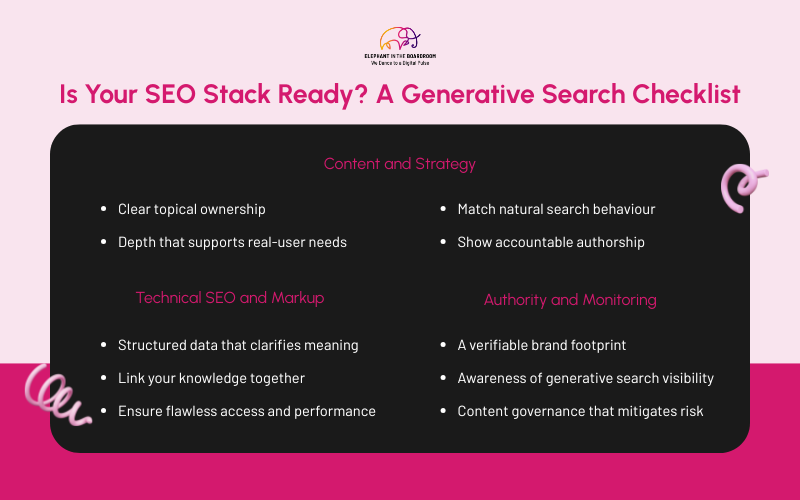
Use the checklist below to assess whether you are genuinely set up for an environment where AI-driven responses shape how users discover and evaluate brands.
Content and Strategy
Clear Topical Ownership
You need a defined content universe that aligns with the subjects your brand should be known for. Generative models learn from patterns. If your content is scattered or inconsistent in tone, expertise, or depth, those patterns dilute your authority. Inconsistent in tone and expertise, those signals weaken your visibility.
Depth that Supports Real-user Needs
AI doesn’t reward surface-level writing. Produce content that demonstrates first-hand knowledge, detailed reasoning, and reliable sourcing. Each piece should prove why your brand deserves to be referenced as a trusted source.
Match Natural Search Behaviour
Queries are now conversational and task-driven. Content should anticipate how real people ask questions and include the context that clarifies intent, without relying on artificial keyword tactics.
Show Accountable Authorship
Every major piece clearly shows who wrote it and why they are qualified. Author pages, citations, and transparent sourcing strengthen trust signals that LLMs rely on.
Technical SEO and Markup
Structured Data that Clarifies Meaning
Schema and markup give AI systems a map of your entities, relationships, and content hierarchy. Correct implementation ensures your site is interpreted as a reliable knowledge source rather than a collection of unconnected pages.
Link Your Knowledge Together
Internal linking and categorisation should clearly indicate how your topics connect. Generative models reward structured, easily navigable sites where relationships between content are obvious.
Ensure Flawless Access and Performance
Generative systems value content they can parse and trust quickly. If your pages are slow, cluttered, or inaccessible, you add friction where clarity is needed. Valid code, accessible design, and mobile responsiveness all contribute to stronger signals.
Authority and Monitoring
A Verifiable Brand Footprint
Your brand should have clear digital proof of expertise: real authors, mentions, citations, industry involvement, and credible third-party references. These external signals are increasingly weighted in generative evaluations.
Awareness of Generative Search Visibility
Track how your content and brand appear in AI-generated summaries, answers, or comparisons. Visibility in these outputs indicates whether your authority is being recognised.
Content Governance that Mitigates Risk
If your content includes unsupported claims, outdated data, or vague positioning, it can harm how your brand is evaluated. A quality assurance framework ensures every piece strengthens your authority.
Unlock Growth with AI-Driven SEO Expertise
Your customers are already discovering brands through AI-generated results, so it is time to put your digital presence in expert hands. Elephant in the Boardroom propels organisations into the AI era with SEO built for generative search. We fuse strategy, creativity, and world-class tech to lift you ahead of competitors still relying on yesterday’s tactics.
Let’s accelerate your growth with solutions that meet search engines where they’re heading. Chat with the global experts in AI-first digital solutions at Elephant in the Boardroom and unleash performance that pushes your brand higher, faster, stronger. Your next big win could start today.
SEO has always been a game of cat and mouse. Marketers chase visibility, search engines change the rules, and the hunt never really ends. But now the cat’s evolved. It can write, predict, and serve answers before the mouse even moves. Generative search has flipped the chase entirely. With over 115 to 180 million people using AI tools every day, the web is no longer a playground of keywords and backlinks, it is now a living, learning ecosystem where AI decides what deserves attention.
So what happens to the mouse? It keeps running, but only with sharper instincts. The tactics that once guaranteed a spot on page one are fading into the background as AI takes control of the spotlight. If your SEO stack can’t handle the new terrain, the chase might be over before you notice. Keep reading to stay in the game while the cat learns new tricks.
What’s Inside:
- Understanding Generative Search and Its Impact on SEO
- Is Your SEO Stack Ready? A Generative Search Checklist
- Unlock Growth with AI-Driven SEO Expertise
Understanding Generative Search and Its Impact on SEO
Generative search represents a fundamental evolution in how people find information online. Powered by large language models (LLMs), these search experiences go beyond returning lists of links, they generate contextual, on-the-fly answers tailored to the user’s query. Examples include Google’s AI Overviews and conversational search models such as Gemini or ChatGPT with browsing capabilities.
This shift is reshaping the SEO landscape in profound ways:
- Search behaviour becomes conversational- Users now engage with search engines using natural, nuanced language. They expect answers that are contextually relevant, precise, and directly actionable, far beyond the generic lists of links that dominated traditional search.
- Fewer clicks to websites- When search engines generate comprehensive answers, users may no longer need to visit multiple pages.
- Greater content exploration- AI models prioritise authoritative, well-structured, and original content. Weak, duplicated, or poorly cited material risks being overlooked entirely.
- Entity-driven discovery- Generative search engines increasingly organise information around entities, like brands, products, people, or locations. The clarity, accuracy, and interconnectivity of how these entities are represented across the web directly impact visibility in AI-generated answers.
- Real expertise gains priority- Search engines assess not just the content itself, but who created it and whether it can be trusted as a reliable source. Authority and transparency now carry measurable weight in discoverability.
What does this mean for your SEO strategy?
Success in the era of generative search goes beyond ranking on page one. It is about becoming a trusted source that AI tools reference, cite, and surface. Achieving this requires:
- Strategic, high-value content that demonstrates expertise and authority.
- Robust technical foundations ensure that content is easily discoverable and clearly structured.
- A verifiable brand presence that search engines can confidently identify, understand, and trust.
In short, SEO is evolving from a game of rankings to a game of trust, relevance, and authoritative visibility. Brands that adapt now will not just survive the AI-powered search era, they will lead it.
Is Your SEO Stack Ready? A Generative Search Checklist
Use the checklist below to assess whether you are genuinely set up for an environment where AI-driven responses shape how users discover and evaluate brands.
Content and Strategy
Clear Topical Ownership
You need a defined content universe that aligns with the subjects your brand should be known for. Generative models learn from patterns. If your content is scattered or inconsistent in tone, expertise, or depth, those patterns dilute your authority. Inconsistent in tone and expertise, those signals weaken your visibility.
Depth that Supports Real-user Needs
AI doesn’t reward surface-level writing. Produce content that demonstrates first-hand knowledge, detailed reasoning, and reliable sourcing. Each piece should prove why your brand deserves to be referenced as a trusted source.
Match Natural Search Behaviour
Queries are now conversational and task-driven. Content should anticipate how real people ask questions and include the context that clarifies intent, without relying on artificial keyword tactics.
Show Accountable Authorship
Every major piece clearly shows who wrote it and why they are qualified. Author pages, citations, and transparent sourcing strengthen trust signals that LLMs rely on.
Technical SEO and Markup
Structured Data that Clarifies Meaning
Schema and markup give AI systems a map of your entities, relationships, and content hierarchy. Correct implementation ensures your site is interpreted as a reliable knowledge source rather than a collection of unconnected pages.
Link Your Knowledge Together
Internal linking and categorisation should clearly indicate how your topics connect. Generative models reward structured, easily navigable sites where relationships between content are obvious.
Ensure Flawless Access and Performance
Generative systems value content they can parse and trust quickly. If your pages are slow, cluttered, or inaccessible, you add friction where clarity is needed. Valid code, accessible design, and mobile responsiveness all contribute to stronger signals.
Authority and Monitoring
A Verifiable Brand Footprint
Your brand should have clear digital proof of expertise: real authors, mentions, citations, industry involvement, and credible third-party references. These external signals are increasingly weighted in generative evaluations.
Awareness of Generative Search Visibility
Track how your content and brand appear in AI-generated summaries, answers, or comparisons. Visibility in these outputs indicates whether your authority is being recognised.
Content Governance that Mitigates Risk
If your content includes unsupported claims, outdated data, or vague positioning, it can harm how your brand is evaluated. A quality assurance framework ensures every piece strengthens your authority.
Unlock Growth with AI-Driven SEO Expertise
Your customers are already discovering brands through AI-generated results, so it is time to put your digital presence in expert hands. Elephant in the Boardroom propels organisations into the AI era with SEO built for generative search. We fuse strategy, creativity, and world-class tech to lift you ahead of competitors still relying on yesterday’s tactics.
Let’s accelerate your growth with solutions that meet search engines where they’re heading. Chat with the global experts in AI-first digital solutions at Elephant in the Boardroom and unleash performance that pushes your brand higher, faster, stronger. Your next big win could start today.
SEO has always been a game of cat and mouse. Marketers chase visibility, search engines change the rules, and the hunt never really ends. But now the cat’s evolved. It can write, predict, and serve answers before the mouse even moves. Generative search has flipped the chase entirely. With over 115 to 180 million people using AI tools every day, the web is no longer a playground of keywords and backlinks, it is now a living, learning ecosystem where AI decides what deserves attention.
So what happens to the mouse? It keeps running, but only with sharper instincts. The tactics that once guaranteed a spot on page one are fading into the background as AI takes control of the spotlight. If your SEO stack can’t handle the new terrain, the chase might be over before you notice. Keep reading to stay in the game while the cat learns new tricks.
What’s Inside:
- Understanding Generative Search and Its Impact on SEO
- Is Your SEO Stack Ready? A Generative Search Checklist
- Unlock Growth with AI-Driven SEO Expertise
Understanding Generative Search and Its Impact on SEO
Generative search represents a fundamental evolution in how people find information online. Powered by large language models (LLMs), these search experiences go beyond returning lists of links, they generate contextual, on-the-fly answers tailored to the user’s query. Examples include Google’s AI Overviews and conversational search models such as Gemini or ChatGPT with browsing capabilities.
This shift is reshaping the SEO landscape in profound ways:
- Search behaviour becomes conversational- Users now engage with search engines using natural, nuanced language. They expect answers that are contextually relevant, precise, and directly actionable, far beyond the generic lists of links that dominated traditional search.
- Fewer clicks to websites- When search engines generate comprehensive answers, users may no longer need to visit multiple pages.
- Greater content exploration- AI models prioritise authoritative, well-structured, and original content. Weak, duplicated, or poorly cited material risks being overlooked entirely.
- Entity-driven discovery- Generative search engines increasingly organise information around entities, like brands, products, people, or locations. The clarity, accuracy, and interconnectivity of how these entities are represented across the web directly impact visibility in AI-generated answers.
- Real expertise gains priority- Search engines assess not just the content itself, but who created it and whether it can be trusted as a reliable source. Authority and transparency now carry measurable weight in discoverability.
What does this mean for your SEO strategy?
Success in the era of generative search goes beyond ranking on page one. It is about becoming a trusted source that AI tools reference, cite, and surface. Achieving this requires:
- Strategic, high-value content that demonstrates expertise and authority.
- Robust technical foundations ensure that content is easily discoverable and clearly structured.
- A verifiable brand presence that search engines can confidently identify, understand, and trust.
In short, SEO is evolving from a game of rankings to a game of trust, relevance, and authoritative visibility. Brands that adapt now will not just survive the AI-powered search era, they will lead it.
Is Your SEO Stack Ready? A Generative Search Checklist
Use the checklist below to assess whether you are genuinely set up for an environment where AI-driven responses shape how users discover and evaluate brands.
Content and Strategy
Clear Topical Ownership
You need a defined content universe that aligns with the subjects your brand should be known for. Generative models learn from patterns. If your content is scattered or inconsistent in tone, expertise, or depth, those patterns dilute your authority. Inconsistent in tone and expertise, those signals weaken your visibility.
Depth that Supports Real-user Needs
AI doesn’t reward surface-level writing. Produce content that demonstrates first-hand knowledge, detailed reasoning, and reliable sourcing. Each piece should prove why your brand deserves to be referenced as a trusted source.
Match Natural Search Behaviour
Queries are now conversational and task-driven. Content should anticipate how real people ask questions and include the context that clarifies intent, without relying on artificial keyword tactics.
Show Accountable Authorship
Every major piece clearly shows who wrote it and why they are qualified. Author pages, citations, and transparent sourcing strengthen trust signals that LLMs rely on.
Technical SEO and Markup
Structured Data that Clarifies Meaning
Schema and markup give AI systems a map of your entities, relationships, and content hierarchy. Correct implementation ensures your site is interpreted as a reliable knowledge source rather than a collection of unconnected pages.
Link Your Knowledge Together
Internal linking and categorisation should clearly indicate how your topics connect. Generative models reward structured, easily navigable sites where relationships between content are obvious.
Ensure Flawless Access and Performance
Generative systems value content they can parse and trust quickly. If your pages are slow, cluttered, or inaccessible, you add friction where clarity is needed. Valid code, accessible design, and mobile responsiveness all contribute to stronger signals.
Authority and Monitoring
A Verifiable Brand Footprint
Your brand should have clear digital proof of expertise: real authors, mentions, citations, industry involvement, and credible third-party references. These external signals are increasingly weighted in generative evaluations.
Awareness of Generative Search Visibility
Track how your content and brand appear in AI-generated summaries, answers, or comparisons. Visibility in these outputs indicates whether your authority is being recognised.
Content Governance that Mitigates Risk
If your content includes unsupported claims, outdated data, or vague positioning, it can harm how your brand is evaluated. A quality assurance framework ensures every piece strengthens your authority.
Unlock Growth with AI-Driven SEO Expertise
Your customers are already discovering brands through AI-generated results, so it is time to put your digital presence in expert hands. Elephant in the Boardroom propels organisations into the AI era with SEO built for generative search. We fuse strategy, creativity, and world-class tech to lift you ahead of competitors still relying on yesterday’s tactics.
Let’s accelerate your growth with solutions that meet search engines where they’re heading. Chat with the global experts in AI-first digital solutions at Elephant in the Boardroom and unleash performance that pushes your brand higher, faster, stronger. Your next big win could start today.
SEO has always been a game of cat and mouse. Marketers chase visibility, search engines change the rules, and the hunt never really ends. But now the cat’s evolved. It can write, predict, and serve answers before the mouse even moves. Generative search has flipped the chase entirely. With over 115 to 180 million people using AI tools every day, the web is no longer a playground of keywords and backlinks, it is now a living, learning ecosystem where AI decides what deserves attention.
So what happens to the mouse? It keeps running, but only with sharper instincts. The tactics that once guaranteed a spot on page one are fading into the background as AI takes control of the spotlight. If your SEO stack can’t handle the new terrain, the chase might be over before you notice. Keep reading to stay in the game while the cat learns new tricks.
What’s Inside:
- Understanding Generative Search and Its Impact on SEO
- Is Your SEO Stack Ready? A Generative Search Checklist
- Unlock Growth with AI-Driven SEO Expertise
Understanding Generative Search and Its Impact on SEO
Generative search represents a fundamental evolution in how people find information online. Powered by large language models (LLMs), these search experiences go beyond returning lists of links, they generate contextual, on-the-fly answers tailored to the user’s query. Examples include Google’s AI Overviews and conversational search models such as Gemini or ChatGPT with browsing capabilities.
This shift is reshaping the SEO landscape in profound ways:
- Search behaviour becomes conversational- Users now engage with search engines using natural, nuanced language. They expect answers that are contextually relevant, precise, and directly actionable, far beyond the generic lists of links that dominated traditional search.
- Fewer clicks to websites- When search engines generate comprehensive answers, users may no longer need to visit multiple pages.
- Greater content exploration- AI models prioritise authoritative, well-structured, and original content. Weak, duplicated, or poorly cited material risks being overlooked entirely.
- Entity-driven discovery- Generative search engines increasingly organise information around entities, like brands, products, people, or locations. The clarity, accuracy, and interconnectivity of how these entities are represented across the web directly impact visibility in AI-generated answers.
- Real expertise gains priority- Search engines assess not just the content itself, but who created it and whether it can be trusted as a reliable source. Authority and transparency now carry measurable weight in discoverability.
What does this mean for your SEO strategy?
Success in the era of generative search goes beyond ranking on page one. It is about becoming a trusted source that AI tools reference, cite, and surface. Achieving this requires:
- Strategic, high-value content that demonstrates expertise and authority.
- Robust technical foundations ensure that content is easily discoverable and clearly structured.
- A verifiable brand presence that search engines can confidently identify, understand, and trust.
In short, SEO is evolving from a game of rankings to a game of trust, relevance, and authoritative visibility. Brands that adapt now will not just survive the AI-powered search era, they will lead it.
Is Your SEO Stack Ready? A Generative Search Checklist
Use the checklist below to assess whether you are genuinely set up for an environment where AI-driven responses shape how users discover and evaluate brands.
Content and Strategy
Clear Topical Ownership
You need a defined content universe that aligns with the subjects your brand should be known for. Generative models learn from patterns. If your content is scattered or inconsistent in tone, expertise, or depth, those patterns dilute your authority. Inconsistent in tone and expertise, those signals weaken your visibility.
Depth that Supports Real-user Needs
AI doesn’t reward surface-level writing. Produce content that demonstrates first-hand knowledge, detailed reasoning, and reliable sourcing. Each piece should prove why your brand deserves to be referenced as a trusted source.
Match Natural Search Behaviour
Queries are now conversational and task-driven. Content should anticipate how real people ask questions and include the context that clarifies intent, without relying on artificial keyword tactics.
Show Accountable Authorship
Every major piece clearly shows who wrote it and why they are qualified. Author pages, citations, and transparent sourcing strengthen trust signals that LLMs rely on.
Technical SEO and Markup
Structured Data that Clarifies Meaning
Schema and markup give AI systems a map of your entities, relationships, and content hierarchy. Correct implementation ensures your site is interpreted as a reliable knowledge source rather than a collection of unconnected pages.
Link Your Knowledge Together
Internal linking and categorisation should clearly indicate how your topics connect. Generative models reward structured, easily navigable sites where relationships between content are obvious.
Ensure Flawless Access and Performance
Generative systems value content they can parse and trust quickly. If your pages are slow, cluttered, or inaccessible, you add friction where clarity is needed. Valid code, accessible design, and mobile responsiveness all contribute to stronger signals.
Authority and Monitoring
A Verifiable Brand Footprint
Your brand should have clear digital proof of expertise: real authors, mentions, citations, industry involvement, and credible third-party references. These external signals are increasingly weighted in generative evaluations.
Awareness of Generative Search Visibility
Track how your content and brand appear in AI-generated summaries, answers, or comparisons. Visibility in these outputs indicates whether your authority is being recognised.
Content Governance that Mitigates Risk
If your content includes unsupported claims, outdated data, or vague positioning, it can harm how your brand is evaluated. A quality assurance framework ensures every piece strengthens your authority.
Unlock Growth with AI-Driven SEO Expertise
Your customers are already discovering brands through AI-generated results, so it is time to put your digital presence in expert hands. Elephant in the Boardroom propels organisations into the AI era with SEO built for generative search. We fuse strategy, creativity, and world-class tech to lift you ahead of competitors still relying on yesterday’s tactics.
Let’s accelerate your growth with solutions that meet search engines where they’re heading. Chat with the global experts in AI-first digital solutions at Elephant in the Boardroom and unleash performance that pushes your brand higher, faster, stronger. Your next big win could start today.
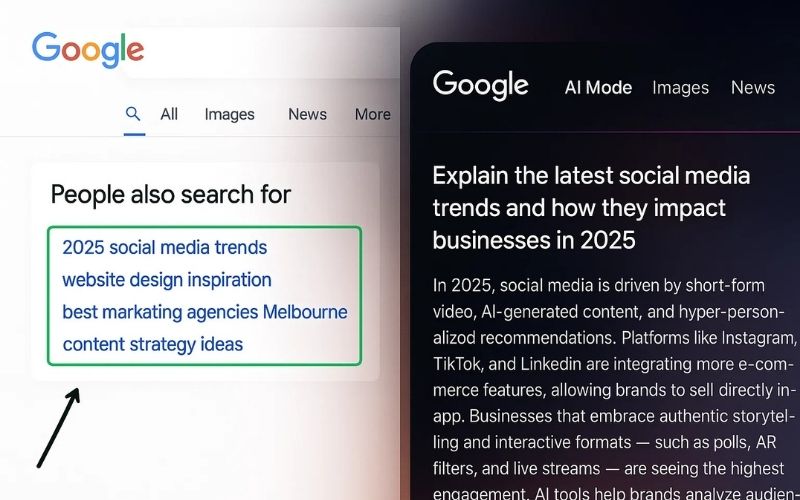
Once upon a search, People Also Search For was the quiet librarian, offering you a neat stack of “you might like this” queries before stepping back into the shadows. Handy, sure. But now? Google’s AI Mode has burst through the library doors, tossing out dusty index cards and replacing them with a dynamic, living conversation. The once-static suggestion box has levelled up into a real-time, context-aware sidekick that evolves with your curiosity.
And this shift isn’t just a tweak; it is a complete remix of the search experience. We are talking about a new rhythm in how queries are answered, connections uncovered, and next steps revealed. If you have ever wanted search to feel less like a chore and more like a discovery you can’t put down, this is where it happens. Let’s unpack how People Also Search For and AI Mode together are rewriting the rules of Search UX.
What’s Inside:
- A Look Back: The Role of People Also Search For in User Discovery
- AI Mode Unpacked: Key Features Driving the Next Search Revolution
- People Also Search For Meets AI Mode: What It Means for Search UX
- Strategies to Elevate Your Brand with AI Mode-Driven Search UX
- Level Up Your Search UX for the AI Mode Era
A Look Back: The Role of People Also Search For in User Discovery
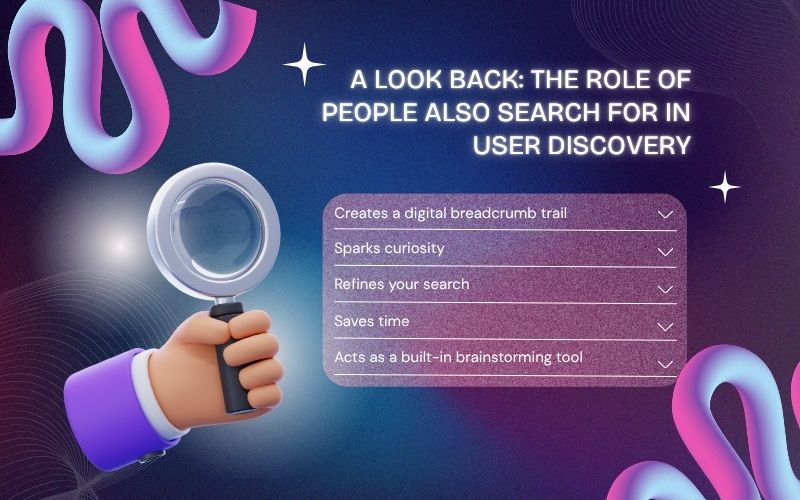
If you have ever clicked on a Google result, then bounced back to the search page, you have probably seen that little box titled People Also Search For. It is Google’s way of saying, “Hey, you might be looking for this too.” These suggestions are based on what other users searched for in similar situations, offering a quick list of related queries right under the result you just explored.
Over the years, this small feature has played a surprisingly big role in how we discover information online:
- Creates a digital breadcrumb trail- Pointing you toward related answers and deeper insights without having to start from scratch.
- Sparks curiosity- Introducing new angles or topics you might not have thought to search for yourself.
- Refines your search- Helping you narrow down results to match your true intent.
- Saves time- Keeping your search flow uninterrupted with instant, relevant suggestions.
- Acts as a built-in brainstorming tool- fuelling your next query just when you think you have exhausted your options.
In short, People Also Search For has quietly shaped the way we explore the web, turning simple searches into wider journeys of discovery.
AI Mode Unpacked: Key Features Driving the Next Search Revolution
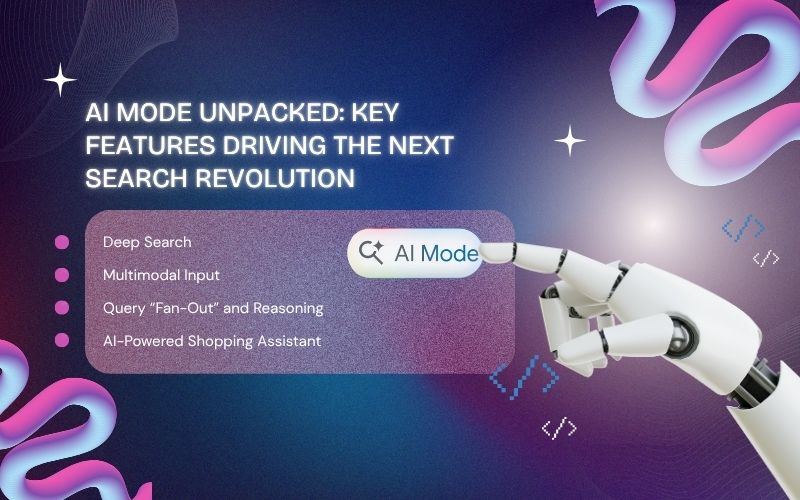
AI Mode is Google’s experiment to make Search feel a lot more like chatting with an intelligent assistant than scanning lists of links. Rolled out in early 2025 via Labs and fully expanded to U.S. users by May 2025, it is powered by the Gemini AI model, initially Gemini 2.0 and now upgraded to Gemini 2.5, bringing advanced reasoning and multimodal capabilities to your search bar.
Here are some of its key features driving the next search revolution:
Deep Search
AI Mode doesn’t just look for keywords; it actively decomposes your query into multiple subtopics, running hundreds of mini-searches in the background. This allows it to synthesise results into a highly detailed, coherent answer that feels like an expertly researched report.
For example, instead of scanning multiple links yourself, you could receive a fully-cited, multi-section answer in minutes, complete with source transparency and the exact time or date the information was pulled.
Multimodal Input
You can interact with AI Mode in the way that feels most natural, by typing, speaking, or even uploading images. It can interpret and respond intelligently to all of them.
For example, you might snap a photo of a plant and ask what it is; AI Mode will not only identify it but also provide care tips, related articles, and visual references. Image-uploaded searches are now clearly marked in your AI Mode history with an image favicon, making it easy to find them later.
Query “Fan-Out” and Reasoning
When you submit a complex question, AI Mode “fans out” the query into many smaller, more specific searches. It then applies reasoning to connect the dots between different pieces of information, building a well-rounded, context-aware answer.
AI-Powered Shopping Assistant
Shopping in AI Mode is more than just product listings; it is an interactive, personalised buying journey. You can upload an image of an outfit, accessory, or gadget you like, and AI Mode will match it with products in Google’s Shopping Graph. New enhancements include:
- 360° product images (generated by Google for better visualisation)
- Price tracking and best price alerts to help you buy at the right time
- People Also Ask (PAA) suggestions to refine your search
- Top insights from review sites, YouTube videos, and even Reddit discussions for authentic user feedback
- Seamless checkout integration via Google Pay
People Also Search For Meets AI Mode: What It Means for Search UX
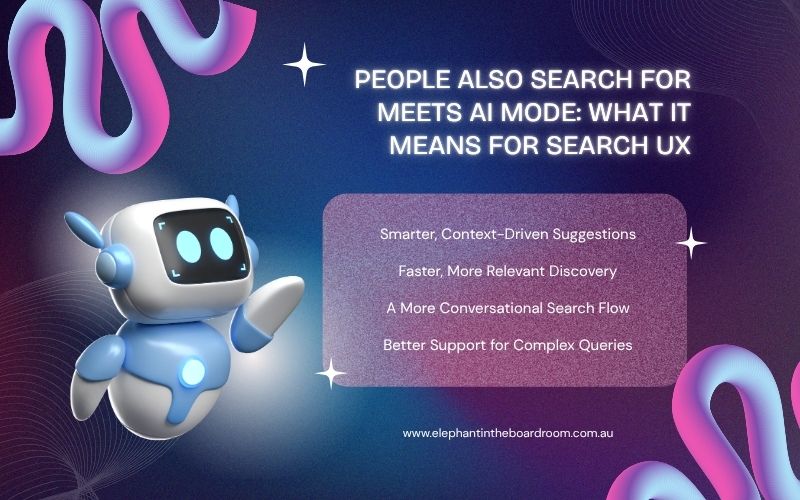
We are in the middle of a search revolution, where the experience matters just as much as the answer. Here’s what it means for search UX:
Smarter, Context-Driven Suggestions
Instead of showing you a static list of related searches, AI Mode can interpret the context of your query in real time. This means the suggestions adapt based on your intent, previous searches, and even follow-up questions. You’re getting results that feel personalised, not just pre-programmed.
Faster, More Relevant Discovery
With AI Mode, the “People Also Search For” section becomes less about random options and more about anticipating your next step. It can surface resources, comparisons, and deeper insights without you having to start a new search. This makes exploring topics quicker and more intuitive.
A More Conversational Search Flow
AI Mode allows you to refine or branch out from your search without jumping back to square one. Instead of just clicking a related term, you can engage with follow-up prompts that expand or narrow your results naturally. It feels more like a dialogue than a list of clickable links.
Better Support for Complex Queries
When your search involves multiple layers, like researching, comparing, and deciding, AI Mode enhances “People Also Search For” to handle that complexity. It can connect related ideas, suggest expert-level content, and guide you toward well-rounded answers. This helps you stay on track, even with tricky topics.
Tips to Elevate Your Brand with AI Mode-Driven Search UX
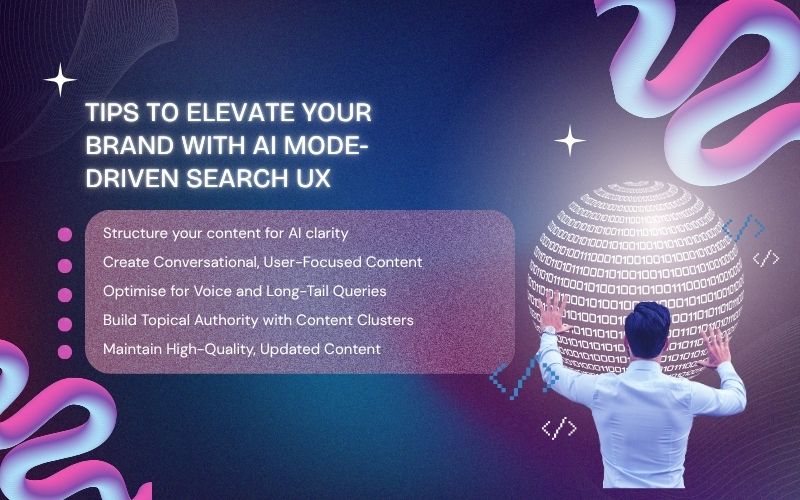
Standing out online has never been more challenging, or more exciting. Search results are getting smarter, faster, and more personal, which means the way you present your brand matters more than ever. Success now comes down to how clearly, confidently, and consistently you show up.
The following are the key strategies to elevate your brand:
Structure Your Content for AI Clarity
Make your content easy for AI to parse by organising it logically with clear headings, bullet points, and short sentences. Use conversational, direct language that reflects how people ask questions. This helps AI models understand your expertise and showcase your brand as an authority.
Create Conversational, User-Focused Content
Write as if you are speaking directly to your audience in a natural, approachable tone. Frame information to answer real questions fully and clearly, anticipating the next queries users might have. This conversational style aligns with how AI now delivers search results, improving your chances of being featured prominently.
Optimise for Voice and Long-Tail Queries
Since voice searches are increasingly common, tailor your content for full, natural-sounding questions rather than short keyword phrases. Use FAQ sections with concise answers and include location-based keywords if relevant to boost local visibility in AI-driven voice searches.
Build Topical Authority with Structured Content Clusters
Develop pillar pages on key topics and surround them with detailed, linked articles that dive into specific sub-questions. This hierarchical approach signals deep expertise in AI, making your brand a go-to source within your niche, increasing discoverability and trust.
Maintain High-Quality, Updated Content
Regularly refresh your content to ensure it remains accurate and relevant. Use schema markup and keep your site fast and user-friendly to help AI systems crawl and interpret your information easily.
Level Up Your Search UX for the AI Mode Era
Now that you know where search is heading, it’s time to make your move. At Elephant in the Boardroom, we help brands take that next step, transforming fresh insight into smart, search-ready experiences that thrive in an AI-driven world. From strategy to design to optimisation, we will make sure your brand isn’t just keeping pace, but setting the pace. Let’s get started.
Once upon a search, People Also Search For was the quiet librarian, offering you a neat stack of “you might like this” queries before stepping back into the shadows. Handy, sure. But now? Google’s AI Mode has burst through the library doors, tossing out dusty index cards and replacing them with a dynamic, living conversation. The once-static suggestion box has levelled up into a real-time, context-aware sidekick that evolves with your curiosity.
And this shift isn’t just a tweak; it is a complete remix of the search experience. We are talking about a new rhythm in how queries are answered, connections uncovered, and next steps revealed. If you have ever wanted search to feel less like a chore and more like a discovery you can’t put down, this is where it happens. Let’s unpack how People Also Search For and AI Mode together are rewriting the rules of Search UX.
What’s Inside:
- A Look Back: The Role of People Also Search For in User Discovery
- AI Mode Unpacked: Key Features Driving the Next Search Revolution
- People Also Search For Meets AI Mode: What It Means for Search UX
- Strategies to Elevate Your Brand with AI Mode-Driven Search UX
- Level Up Your Search UX for the AI Mode Era
A Look Back: The Role of People Also Search For in User Discovery
If you have ever clicked on a Google result, then bounced back to the search page, you have probably seen that little box titled People Also Search For. It is Google’s way of saying, “Hey, you might be looking for this too.” These suggestions are based on what other users searched for in similar situations, offering a quick list of related queries right under the result you just explored.
Over the years, this small feature has played a surprisingly big role in how we discover information online:
- Creates a digital breadcrumb trail- Pointing you toward related answers and deeper insights without having to start from scratch.
- Sparks curiosity- Introducing new angles or topics you might not have thought to search for yourself.
- Refines your search- Helping you narrow down results to match your true intent.
- Saves time- Keeping your search flow uninterrupted with instant, relevant suggestions.
- Acts as a built-in brainstorming tool- fuelling your next query just when you think you have exhausted your options.
In short, People Also Search For has quietly shaped the way we explore the web, turning simple searches into wider journeys of discovery.
AI Mode Unpacked: Key Features Driving the Next Search Revolution
AI Mode is Google’s experiment to make Search feel a lot more like chatting with an intelligent assistant than scanning lists of links. Rolled out in early 2025 via Labs and fully expanded to U.S. users by May 2025, it is powered by the Gemini AI model, initially Gemini 2.0 and now upgraded to Gemini 2.5, bringing advanced reasoning and multimodal capabilities to your search bar.
Here are some of its key features driving the next search revolution:
Deep Search
AI Mode doesn’t just look for keywords; it actively decomposes your query into multiple subtopics, running hundreds of mini-searches in the background. This allows it to synthesise results into a highly detailed, coherent answer that feels like an expertly researched report.
For example, instead of scanning multiple links yourself, you could receive a fully-cited, multi-section answer in minutes, complete with source transparency and the exact time or date the information was pulled.
Multimodal Input
You can interact with AI Mode in the way that feels most natural, by typing, speaking, or even uploading images. It can interpret and respond intelligently to all of them.
For example, you might snap a photo of a plant and ask what it is; AI Mode will not only identify it but also provide care tips, related articles, and visual references. Image-uploaded searches are now clearly marked in your AI Mode history with an image favicon, making it easy to find them later.
Query “Fan-Out” and Reasoning
When you submit a complex question, AI Mode “fans out” the query into many smaller, more specific searches. It then applies reasoning to connect the dots between different pieces of information, building a well-rounded, context-aware answer.
AI-Powered Shopping Assistant
Shopping in AI Mode is more than just product listings; it is an interactive, personalised buying journey. You can upload an image of an outfit, accessory, or gadget you like, and AI Mode will match it with products in Google’s Shopping Graph. New enhancements include:
- 360° product images (generated by Google for better visualisation)
- Price tracking and best price alerts to help you buy at the right time
- People Also Ask (PAA) suggestions to refine your search
- Top insights from review sites, YouTube videos, and even Reddit discussions for authentic user feedback
- Seamless checkout integration via Google Pay
People Also Search For Meets AI Mode: What It Means for Search UX
We are in the middle of a search revolution, where the experience matters just as much as the answer. Here’s what it means for search UX:
Smarter, Context-Driven Suggestions
Instead of showing you a static list of related searches, AI Mode can interpret the context of your query in real time. This means the suggestions adapt based on your intent, previous searches, and even follow-up questions. You’re getting results that feel personalised, not just pre-programmed.
Faster, More Relevant Discovery
With AI Mode, the “People Also Search For” section becomes less about random options and more about anticipating your next step. It can surface resources, comparisons, and deeper insights without you having to start a new search. This makes exploring topics quicker and more intuitive.
A More Conversational Search Flow
AI Mode allows you to refine or branch out from your search without jumping back to square one. Instead of just clicking a related term, you can engage with follow-up prompts that expand or narrow your results naturally. It feels more like a dialogue than a list of clickable links.
Better Support for Complex Queries
When your search involves multiple layers, like researching, comparing, and deciding, AI Mode enhances “People Also Search For” to handle that complexity. It can connect related ideas, suggest expert-level content, and guide you toward well-rounded answers. This helps you stay on track, even with tricky topics.
Tips to Elevate Your Brand with AI Mode-Driven Search UX
Standing out online has never been more challenging, or more exciting. Search results are getting smarter, faster, and more personal, which means the way you present your brand matters more than ever. Success now comes down to how clearly, confidently, and consistently you show up.
The following are the key strategies to elevate your brand:
Structure Your Content for AI Clarity
Make your content easy for AI to parse by organising it logically with clear headings, bullet points, and short sentences. Use conversational, direct language that reflects how people ask questions. This helps AI models understand your expertise and showcase your brand as an authority.
Create Conversational, User-Focused Content
Write as if you are speaking directly to your audience in a natural, approachable tone. Frame information to answer real questions fully and clearly, anticipating the next queries users might have. This conversational style aligns with how AI now delivers search results, improving your chances of being featured prominently.
Optimise for Voice and Long-Tail Queries
Since voice searches are increasingly common, tailor your content for full, natural-sounding questions rather than short keyword phrases. Use FAQ sections with concise answers and include location-based keywords if relevant to boost local visibility in AI-driven voice searches.
Build Topical Authority with Structured Content Clusters
Develop pillar pages on key topics and surround them with detailed, linked articles that dive into specific sub-questions. This hierarchical approach signals deep expertise in AI, making your brand a go-to source within your niche, increasing discoverability and trust.
Maintain High-Quality, Updated Content
Regularly refresh your content to ensure it remains accurate and relevant. Use schema markup and keep your site fast and user-friendly to help AI systems crawl and interpret your information easily.
Level Up Your Search UX for the AI Mode Era
Now that you know where search is heading, it’s time to make your move. At Elephant in the Boardroom, we help brands take that next step, transforming fresh insight into smart, search-ready experiences that thrive in an AI-driven world. From strategy to design to optimisation, we will make sure your brand isn’t just keeping pace, but setting the pace. Let’s get started.
Once upon a search, People Also Search For was the quiet librarian, offering you a neat stack of “you might like this” queries before stepping back into the shadows. Handy, sure. But now? Google’s AI Mode has burst through the library doors, tossing out dusty index cards and replacing them with a dynamic, living conversation. The once-static suggestion box has levelled up into a real-time, context-aware sidekick that evolves with your curiosity.
And this shift isn’t just a tweak; it is a complete remix of the search experience. We are talking about a new rhythm in how queries are answered, connections uncovered, and next steps revealed. If you have ever wanted search to feel less like a chore and more like a discovery you can’t put down, this is where it happens. Let’s unpack how People Also Search For and AI Mode together are rewriting the rules of Search UX.
What’s Inside:
- A Look Back: The Role of People Also Search For in User Discovery
- AI Mode Unpacked: Key Features Driving the Next Search Revolution
- People Also Search For Meets AI Mode: What It Means for Search UX
- Strategies to Elevate Your Brand with AI Mode-Driven Search UX
- Level Up Your Search UX for the AI Mode Era
A Look Back: The Role of People Also Search For in User Discovery
If you have ever clicked on a Google result, then bounced back to the search page, you have probably seen that little box titled People Also Search For. It is Google’s way of saying, “Hey, you might be looking for this too.” These suggestions are based on what other users searched for in similar situations, offering a quick list of related queries right under the result you just explored.
Over the years, this small feature has played a surprisingly big role in how we discover information online:
- Creates a digital breadcrumb trail- Pointing you toward related answers and deeper insights without having to start from scratch.
- Sparks curiosity- Introducing new angles or topics you might not have thought to search for yourself.
- Refines your search- Helping you narrow down results to match your true intent.
- Saves time- Keeping your search flow uninterrupted with instant, relevant suggestions.
- Acts as a built-in brainstorming tool- fuelling your next query just when you think you have exhausted your options.
In short, People Also Search For has quietly shaped the way we explore the web, turning simple searches into wider journeys of discovery.
AI Mode Unpacked: Key Features Driving the Next Search Revolution
AI Mode is Google’s experiment to make Search feel a lot more like chatting with an intelligent assistant than scanning lists of links. Rolled out in early 2025 via Labs and fully expanded to U.S. users by May 2025, it is powered by the Gemini AI model, initially Gemini 2.0 and now upgraded to Gemini 2.5, bringing advanced reasoning and multimodal capabilities to your search bar.
Here are some of its key features driving the next search revolution:
Deep Search
AI Mode doesn’t just look for keywords; it actively decomposes your query into multiple subtopics, running hundreds of mini-searches in the background. This allows it to synthesise results into a highly detailed, coherent answer that feels like an expertly researched report.
For example, instead of scanning multiple links yourself, you could receive a fully-cited, multi-section answer in minutes, complete with source transparency and the exact time or date the information was pulled.
Multimodal Input
You can interact with AI Mode in the way that feels most natural, by typing, speaking, or even uploading images. It can interpret and respond intelligently to all of them.
For example, you might snap a photo of a plant and ask what it is; AI Mode will not only identify it but also provide care tips, related articles, and visual references. Image-uploaded searches are now clearly marked in your AI Mode history with an image favicon, making it easy to find them later.
Query “Fan-Out” and Reasoning
When you submit a complex question, AI Mode “fans out” the query into many smaller, more specific searches. It then applies reasoning to connect the dots between different pieces of information, building a well-rounded, context-aware answer.
AI-Powered Shopping Assistant
Shopping in AI Mode is more than just product listings; it is an interactive, personalised buying journey. You can upload an image of an outfit, accessory, or gadget you like, and AI Mode will match it with products in Google’s Shopping Graph. New enhancements include:
- 360° product images (generated by Google for better visualisation)
- Price tracking and best price alerts to help you buy at the right time
- People Also Ask (PAA) suggestions to refine your search
- Top insights from review sites, YouTube videos, and even Reddit discussions for authentic user feedback
- Seamless checkout integration via Google Pay
People Also Search For Meets AI Mode: What It Means for Search UX
We are in the middle of a search revolution, where the experience matters just as much as the answer. Here’s what it means for search UX:
Smarter, Context-Driven Suggestions
Instead of showing you a static list of related searches, AI Mode can interpret the context of your query in real time. This means the suggestions adapt based on your intent, previous searches, and even follow-up questions. You’re getting results that feel personalised, not just pre-programmed.
Faster, More Relevant Discovery
With AI Mode, the “People Also Search For” section becomes less about random options and more about anticipating your next step. It can surface resources, comparisons, and deeper insights without you having to start a new search. This makes exploring topics quicker and more intuitive.
A More Conversational Search Flow
AI Mode allows you to refine or branch out from your search without jumping back to square one. Instead of just clicking a related term, you can engage with follow-up prompts that expand or narrow your results naturally. It feels more like a dialogue than a list of clickable links.
Better Support for Complex Queries
When your search involves multiple layers, like researching, comparing, and deciding, AI Mode enhances “People Also Search For” to handle that complexity. It can connect related ideas, suggest expert-level content, and guide you toward well-rounded answers. This helps you stay on track, even with tricky topics.
Tips to Elevate Your Brand with AI Mode-Driven Search UX
Standing out online has never been more challenging, or more exciting. Search results are getting smarter, faster, and more personal, which means the way you present your brand matters more than ever. Success now comes down to how clearly, confidently, and consistently you show up.
The following are the key strategies to elevate your brand:
Structure Your Content for AI Clarity
Make your content easy for AI to parse by organising it logically with clear headings, bullet points, and short sentences. Use conversational, direct language that reflects how people ask questions. This helps AI models understand your expertise and showcase your brand as an authority.
Create Conversational, User-Focused Content
Write as if you are speaking directly to your audience in a natural, approachable tone. Frame information to answer real questions fully and clearly, anticipating the next queries users might have. This conversational style aligns with how AI now delivers search results, improving your chances of being featured prominently.
Optimise for Voice and Long-Tail Queries
Since voice searches are increasingly common, tailor your content for full, natural-sounding questions rather than short keyword phrases. Use FAQ sections with concise answers and include location-based keywords if relevant to boost local visibility in AI-driven voice searches.
Build Topical Authority with Structured Content Clusters
Develop pillar pages on key topics and surround them with detailed, linked articles that dive into specific sub-questions. This hierarchical approach signals deep expertise in AI, making your brand a go-to source within your niche, increasing discoverability and trust.
Maintain High-Quality, Updated Content
Regularly refresh your content to ensure it remains accurate and relevant. Use schema markup and keep your site fast and user-friendly to help AI systems crawl and interpret your information easily.
Level Up Your Search UX for the AI Mode Era
Now that you know where search is heading, it’s time to make your move. At Elephant in the Boardroom, we help brands take that next step, transforming fresh insight into smart, search-ready experiences that thrive in an AI-driven world. From strategy to design to optimisation, we will make sure your brand isn’t just keeping pace, but setting the pace. Let’s get started.
Once upon a search, People Also Search For was the quiet librarian, offering you a neat stack of “you might like this” queries before stepping back into the shadows. Handy, sure. But now? Google’s AI Mode has burst through the library doors, tossing out dusty index cards and replacing them with a dynamic, living conversation. The once-static suggestion box has levelled up into a real-time, context-aware sidekick that evolves with your curiosity.
And this shift isn’t just a tweak; it is a complete remix of the search experience. We are talking about a new rhythm in how queries are answered, connections uncovered, and next steps revealed. If you have ever wanted search to feel less like a chore and more like a discovery you can’t put down, this is where it happens. Let’s unpack how People Also Search For and AI Mode together are rewriting the rules of Search UX.
What’s Inside:
- A Look Back: The Role of People Also Search For in User Discovery
- AI Mode Unpacked: Key Features Driving the Next Search Revolution
- People Also Search For Meets AI Mode: What It Means for Search UX
- Strategies to Elevate Your Brand with AI Mode-Driven Search UX
- Level Up Your Search UX for the AI Mode Era
A Look Back: The Role of People Also Search For in User Discovery
If you have ever clicked on a Google result, then bounced back to the search page, you have probably seen that little box titled People Also Search For. It is Google’s way of saying, “Hey, you might be looking for this too.” These suggestions are based on what other users searched for in similar situations, offering a quick list of related queries right under the result you just explored.
Over the years, this small feature has played a surprisingly big role in how we discover information online:
- Creates a digital breadcrumb trail- Pointing you toward related answers and deeper insights without having to start from scratch.
- Sparks curiosity- Introducing new angles or topics you might not have thought to search for yourself.
- Refines your search- Helping you narrow down results to match your true intent.
- Saves time- Keeping your search flow uninterrupted with instant, relevant suggestions.
- Acts as a built-in brainstorming tool- fuelling your next query just when you think you have exhausted your options.
In short, People Also Search For has quietly shaped the way we explore the web, turning simple searches into wider journeys of discovery.
AI Mode Unpacked: Key Features Driving the Next Search Revolution
AI Mode is Google’s experiment to make Search feel a lot more like chatting with an intelligent assistant than scanning lists of links. Rolled out in early 2025 via Labs and fully expanded to U.S. users by May 2025, it is powered by the Gemini AI model, initially Gemini 2.0 and now upgraded to Gemini 2.5, bringing advanced reasoning and multimodal capabilities to your search bar.
Here are some of its key features driving the next search revolution:
Deep Search
AI Mode doesn’t just look for keywords; it actively decomposes your query into multiple subtopics, running hundreds of mini-searches in the background. This allows it to synthesise results into a highly detailed, coherent answer that feels like an expertly researched report.
For example, instead of scanning multiple links yourself, you could receive a fully-cited, multi-section answer in minutes, complete with source transparency and the exact time or date the information was pulled.
Multimodal Input
You can interact with AI Mode in the way that feels most natural, by typing, speaking, or even uploading images. It can interpret and respond intelligently to all of them.
For example, you might snap a photo of a plant and ask what it is; AI Mode will not only identify it but also provide care tips, related articles, and visual references. Image-uploaded searches are now clearly marked in your AI Mode history with an image favicon, making it easy to find them later.
Query “Fan-Out” and Reasoning
When you submit a complex question, AI Mode “fans out” the query into many smaller, more specific searches. It then applies reasoning to connect the dots between different pieces of information, building a well-rounded, context-aware answer.
AI-Powered Shopping Assistant
Shopping in AI Mode is more than just product listings; it is an interactive, personalised buying journey. You can upload an image of an outfit, accessory, or gadget you like, and AI Mode will match it with products in Google’s Shopping Graph. New enhancements include:
- 360° product images (generated by Google for better visualisation)
- Price tracking and best price alerts to help you buy at the right time
- People Also Ask (PAA) suggestions to refine your search
- Top insights from review sites, YouTube videos, and even Reddit discussions for authentic user feedback
- Seamless checkout integration via Google Pay
People Also Search For Meets AI Mode: What It Means for Search UX
We are in the middle of a search revolution, where the experience matters just as much as the answer. Here’s what it means for search UX:
Smarter, Context-Driven Suggestions
Instead of showing you a static list of related searches, AI Mode can interpret the context of your query in real time. This means the suggestions adapt based on your intent, previous searches, and even follow-up questions. You’re getting results that feel personalised, not just pre-programmed.
Faster, More Relevant Discovery
With AI Mode, the “People Also Search For” section becomes less about random options and more about anticipating your next step. It can surface resources, comparisons, and deeper insights without you having to start a new search. This makes exploring topics quicker and more intuitive.
A More Conversational Search Flow
AI Mode allows you to refine or branch out from your search without jumping back to square one. Instead of just clicking a related term, you can engage with follow-up prompts that expand or narrow your results naturally. It feels more like a dialogue than a list of clickable links.
Better Support for Complex Queries
When your search involves multiple layers, like researching, comparing, and deciding, AI Mode enhances “People Also Search For” to handle that complexity. It can connect related ideas, suggest expert-level content, and guide you toward well-rounded answers. This helps you stay on track, even with tricky topics.
Tips to Elevate Your Brand with AI Mode-Driven Search UX
Standing out online has never been more challenging, or more exciting. Search results are getting smarter, faster, and more personal, which means the way you present your brand matters more than ever. Success now comes down to how clearly, confidently, and consistently you show up.
The following are the key strategies to elevate your brand:
Structure Your Content for AI Clarity
Make your content easy for AI to parse by organising it logically with clear headings, bullet points, and short sentences. Use conversational, direct language that reflects how people ask questions. This helps AI models understand your expertise and showcase your brand as an authority.
Create Conversational, User-Focused Content
Write as if you are speaking directly to your audience in a natural, approachable tone. Frame information to answer real questions fully and clearly, anticipating the next queries users might have. This conversational style aligns with how AI now delivers search results, improving your chances of being featured prominently.
Optimise for Voice and Long-Tail Queries
Since voice searches are increasingly common, tailor your content for full, natural-sounding questions rather than short keyword phrases. Use FAQ sections with concise answers and include location-based keywords if relevant to boost local visibility in AI-driven voice searches.
Build Topical Authority with Structured Content Clusters
Develop pillar pages on key topics and surround them with detailed, linked articles that dive into specific sub-questions. This hierarchical approach signals deep expertise in AI, making your brand a go-to source within your niche, increasing discoverability and trust.
Maintain High-Quality, Updated Content
Regularly refresh your content to ensure it remains accurate and relevant. Use schema markup and keep your site fast and user-friendly to help AI systems crawl and interpret your information easily.
Level Up Your Search UX for the AI Mode Era
Now that you know where search is heading, it’s time to make your move. At Elephant in the Boardroom, we help brands take that next step, transforming fresh insight into smart, search-ready experiences that thrive in an AI-driven world. From strategy to design to optimisation, we will make sure your brand isn’t just keeping pace, but setting the pace. Let’s get started.
Once upon a search, People Also Search For was the quiet librarian, offering you a neat stack of “you might like this” queries before stepping back into the shadows. Handy, sure. But now? Google’s AI Mode has burst through the library doors, tossing out dusty index cards and replacing them with a dynamic, living conversation. The once-static suggestion box has levelled up into a real-time, context-aware sidekick that evolves with your curiosity.
And this shift isn’t just a tweak; it is a complete remix of the search experience. We are talking about a new rhythm in how queries are answered, connections uncovered, and next steps revealed. If you have ever wanted search to feel less like a chore and more like a discovery you can’t put down, this is where it happens. Let’s unpack how People Also Search For and AI Mode together are rewriting the rules of Search UX.
What’s Inside:
- A Look Back: The Role of People Also Search For in User Discovery
- AI Mode Unpacked: Key Features Driving the Next Search Revolution
- People Also Search For Meets AI Mode: What It Means for Search UX
- Strategies to Elevate Your Brand with AI Mode-Driven Search UX
- Level Up Your Search UX for the AI Mode Era
A Look Back: The Role of People Also Search For in User Discovery
If you have ever clicked on a Google result, then bounced back to the search page, you have probably seen that little box titled People Also Search For. It is Google’s way of saying, “Hey, you might be looking for this too.” These suggestions are based on what other users searched for in similar situations, offering a quick list of related queries right under the result you just explored.
Over the years, this small feature has played a surprisingly big role in how we discover information online:
- Creates a digital breadcrumb trail- Pointing you toward related answers and deeper insights without having to start from scratch.
- Sparks curiosity- Introducing new angles or topics you might not have thought to search for yourself.
- Refines your search- Helping you narrow down results to match your true intent.
- Saves time- Keeping your search flow uninterrupted with instant, relevant suggestions.
- Acts as a built-in brainstorming tool- fuelling your next query just when you think you have exhausted your options.
In short, People Also Search For has quietly shaped the way we explore the web, turning simple searches into wider journeys of discovery.
AI Mode Unpacked: Key Features Driving the Next Search Revolution
AI Mode is Google’s experiment to make Search feel a lot more like chatting with an intelligent assistant than scanning lists of links. Rolled out in early 2025 via Labs and fully expanded to U.S. users by May 2025, it is powered by the Gemini AI model, initially Gemini 2.0 and now upgraded to Gemini 2.5, bringing advanced reasoning and multimodal capabilities to your search bar.
Here are some of its key features driving the next search revolution:
Deep Search
AI Mode doesn’t just look for keywords; it actively decomposes your query into multiple subtopics, running hundreds of mini-searches in the background. This allows it to synthesise results into a highly detailed, coherent answer that feels like an expertly researched report.
For example, instead of scanning multiple links yourself, you could receive a fully-cited, multi-section answer in minutes, complete with source transparency and the exact time or date the information was pulled.
Multimodal Input
You can interact with AI Mode in the way that feels most natural, by typing, speaking, or even uploading images. It can interpret and respond intelligently to all of them.
For example, you might snap a photo of a plant and ask what it is; AI Mode will not only identify it but also provide care tips, related articles, and visual references. Image-uploaded searches are now clearly marked in your AI Mode history with an image favicon, making it easy to find them later.
Query “Fan-Out” and Reasoning
When you submit a complex question, AI Mode “fans out” the query into many smaller, more specific searches. It then applies reasoning to connect the dots between different pieces of information, building a well-rounded, context-aware answer.
AI-Powered Shopping Assistant
Shopping in AI Mode is more than just product listings; it is an interactive, personalised buying journey. You can upload an image of an outfit, accessory, or gadget you like, and AI Mode will match it with products in Google’s Shopping Graph. New enhancements include:
- 360° product images (generated by Google for better visualisation)
- Price tracking and best price alerts to help you buy at the right time
- People Also Ask (PAA) suggestions to refine your search
- Top insights from review sites, YouTube videos, and even Reddit discussions for authentic user feedback
- Seamless checkout integration via Google Pay
People Also Search For Meets AI Mode: What It Means for Search UX
We are in the middle of a search revolution, where the experience matters just as much as the answer. Here’s what it means for search UX:
Smarter, Context-Driven Suggestions
Instead of showing you a static list of related searches, AI Mode can interpret the context of your query in real time. This means the suggestions adapt based on your intent, previous searches, and even follow-up questions. You’re getting results that feel personalised, not just pre-programmed.
Faster, More Relevant Discovery
With AI Mode, the “People Also Search For” section becomes less about random options and more about anticipating your next step. It can surface resources, comparisons, and deeper insights without you having to start a new search. This makes exploring topics quicker and more intuitive.
A More Conversational Search Flow
AI Mode allows you to refine or branch out from your search without jumping back to square one. Instead of just clicking a related term, you can engage with follow-up prompts that expand or narrow your results naturally. It feels more like a dialogue than a list of clickable links.
Better Support for Complex Queries
When your search involves multiple layers, like researching, comparing, and deciding, AI Mode enhances “People Also Search For” to handle that complexity. It can connect related ideas, suggest expert-level content, and guide you toward well-rounded answers. This helps you stay on track, even with tricky topics.
Tips to Elevate Your Brand with AI Mode-Driven Search UX
Standing out online has never been more challenging, or more exciting. Search results are getting smarter, faster, and more personal, which means the way you present your brand matters more than ever. Success now comes down to how clearly, confidently, and consistently you show up.
The following are the key strategies to elevate your brand:
Structure Your Content for AI Clarity
Make your content easy for AI to parse by organising it logically with clear headings, bullet points, and short sentences. Use conversational, direct language that reflects how people ask questions. This helps AI models understand your expertise and showcase your brand as an authority.
Create Conversational, User-Focused Content
Write as if you are speaking directly to your audience in a natural, approachable tone. Frame information to answer real questions fully and clearly, anticipating the next queries users might have. This conversational style aligns with how AI now delivers search results, improving your chances of being featured prominently.
Optimise for Voice and Long-Tail Queries
Since voice searches are increasingly common, tailor your content for full, natural-sounding questions rather than short keyword phrases. Use FAQ sections with concise answers and include location-based keywords if relevant to boost local visibility in AI-driven voice searches.
Build Topical Authority with Structured Content Clusters
Develop pillar pages on key topics and surround them with detailed, linked articles that dive into specific sub-questions. This hierarchical approach signals deep expertise in AI, making your brand a go-to source within your niche, increasing discoverability and trust.
Maintain High-Quality, Updated Content
Regularly refresh your content to ensure it remains accurate and relevant. Use schema markup and keep your site fast and user-friendly to help AI systems crawl and interpret your information easily.
Level Up Your Search UX for the AI Mode Era
Now that you know where search is heading, it’s time to make your move. At Elephant in the Boardroom, we help brands take that next step, transforming fresh insight into smart, search-ready experiences that thrive in an AI-driven world. From strategy to design to optimisation, we will make sure your brand isn’t just keeping pace, but setting the pace. Let’s get started.
Once upon a search, People Also Search For was the quiet librarian, offering you a neat stack of “you might like this” queries before stepping back into the shadows. Handy, sure. But now? Google’s AI Mode has burst through the library doors, tossing out dusty index cards and replacing them with a dynamic, living conversation. The once-static suggestion box has levelled up into a real-time, context-aware sidekick that evolves with your curiosity.
And this shift isn’t just a tweak; it is a complete remix of the search experience. We are talking about a new rhythm in how queries are answered, connections uncovered, and next steps revealed. If you have ever wanted search to feel less like a chore and more like a discovery you can’t put down, this is where it happens. Let’s unpack how People Also Search For and AI Mode together are rewriting the rules of Search UX.
What’s Inside:
- A Look Back: The Role of People Also Search For in User Discovery
- AI Mode Unpacked: Key Features Driving the Next Search Revolution
- People Also Search For Meets AI Mode: What It Means for Search UX
- Strategies to Elevate Your Brand with AI Mode-Driven Search UX
- Level Up Your Search UX for the AI Mode Era
A Look Back: The Role of People Also Search For in User Discovery
If you have ever clicked on a Google result, then bounced back to the search page, you have probably seen that little box titled People Also Search For. It is Google’s way of saying, “Hey, you might be looking for this too.” These suggestions are based on what other users searched for in similar situations, offering a quick list of related queries right under the result you just explored.
Over the years, this small feature has played a surprisingly big role in how we discover information online:
- Creates a digital breadcrumb trail- Pointing you toward related answers and deeper insights without having to start from scratch.
- Sparks curiosity- Introducing new angles or topics you might not have thought to search for yourself.
- Refines your search- Helping you narrow down results to match your true intent.
- Saves time- Keeping your search flow uninterrupted with instant, relevant suggestions.
- Acts as a built-in brainstorming tool- fuelling your next query just when you think you have exhausted your options.
In short, People Also Search For has quietly shaped the way we explore the web, turning simple searches into wider journeys of discovery.
AI Mode Unpacked: Key Features Driving the Next Search Revolution
AI Mode is Google’s experiment to make Search feel a lot more like chatting with an intelligent assistant than scanning lists of links. Rolled out in early 2025 via Labs and fully expanded to U.S. users by May 2025, it is powered by the Gemini AI model, initially Gemini 2.0 and now upgraded to Gemini 2.5, bringing advanced reasoning and multimodal capabilities to your search bar.
Here are some of its key features driving the next search revolution:
Deep Search
AI Mode doesn’t just look for keywords; it actively decomposes your query into multiple subtopics, running hundreds of mini-searches in the background. This allows it to synthesise results into a highly detailed, coherent answer that feels like an expertly researched report.
For example, instead of scanning multiple links yourself, you could receive a fully-cited, multi-section answer in minutes, complete with source transparency and the exact time or date the information was pulled.
Multimodal Input
You can interact with AI Mode in the way that feels most natural, by typing, speaking, or even uploading images. It can interpret and respond intelligently to all of them.
For example, you might snap a photo of a plant and ask what it is; AI Mode will not only identify it but also provide care tips, related articles, and visual references. Image-uploaded searches are now clearly marked in your AI Mode history with an image favicon, making it easy to find them later.
Query “Fan-Out” and Reasoning
When you submit a complex question, AI Mode “fans out” the query into many smaller, more specific searches. It then applies reasoning to connect the dots between different pieces of information, building a well-rounded, context-aware answer.
AI-Powered Shopping Assistant
Shopping in AI Mode is more than just product listings; it is an interactive, personalised buying journey. You can upload an image of an outfit, accessory, or gadget you like, and AI Mode will match it with products in Google’s Shopping Graph. New enhancements include:
- 360° product images (generated by Google for better visualisation)
- Price tracking and best price alerts to help you buy at the right time
- People Also Ask (PAA) suggestions to refine your search
- Top insights from review sites, YouTube videos, and even Reddit discussions for authentic user feedback
- Seamless checkout integration via Google Pay
People Also Search For Meets AI Mode: What It Means for Search UX
We are in the middle of a search revolution, where the experience matters just as much as the answer. Here’s what it means for search UX:
Smarter, Context-Driven Suggestions
Instead of showing you a static list of related searches, AI Mode can interpret the context of your query in real time. This means the suggestions adapt based on your intent, previous searches, and even follow-up questions. You’re getting results that feel personalised, not just pre-programmed.
Faster, More Relevant Discovery
With AI Mode, the “People Also Search For” section becomes less about random options and more about anticipating your next step. It can surface resources, comparisons, and deeper insights without you having to start a new search. This makes exploring topics quicker and more intuitive.
A More Conversational Search Flow
AI Mode allows you to refine or branch out from your search without jumping back to square one. Instead of just clicking a related term, you can engage with follow-up prompts that expand or narrow your results naturally. It feels more like a dialogue than a list of clickable links.
Better Support for Complex Queries
When your search involves multiple layers, like researching, comparing, and deciding, AI Mode enhances “People Also Search For” to handle that complexity. It can connect related ideas, suggest expert-level content, and guide you toward well-rounded answers. This helps you stay on track, even with tricky topics.
Tips to Elevate Your Brand with AI Mode-Driven Search UX
Standing out online has never been more challenging, or more exciting. Search results are getting smarter, faster, and more personal, which means the way you present your brand matters more than ever. Success now comes down to how clearly, confidently, and consistently you show up.
The following are the key strategies to elevate your brand:
Structure Your Content for AI Clarity
Make your content easy for AI to parse by organising it logically with clear headings, bullet points, and short sentences. Use conversational, direct language that reflects how people ask questions. This helps AI models understand your expertise and showcase your brand as an authority.
Create Conversational, User-Focused Content
Write as if you are speaking directly to your audience in a natural, approachable tone. Frame information to answer real questions fully and clearly, anticipating the next queries users might have. This conversational style aligns with how AI now delivers search results, improving your chances of being featured prominently.
Optimise for Voice and Long-Tail Queries
Since voice searches are increasingly common, tailor your content for full, natural-sounding questions rather than short keyword phrases. Use FAQ sections with concise answers and include location-based keywords if relevant to boost local visibility in AI-driven voice searches.
Build Topical Authority with Structured Content Clusters
Develop pillar pages on key topics and surround them with detailed, linked articles that dive into specific sub-questions. This hierarchical approach signals deep expertise in AI, making your brand a go-to source within your niche, increasing discoverability and trust.
Maintain High-Quality, Updated Content
Regularly refresh your content to ensure it remains accurate and relevant. Use schema markup and keep your site fast and user-friendly to help AI systems crawl and interpret your information easily.
Level Up Your Search UX for the AI Mode Era
Now that you know where search is heading, it’s time to make your move. At Elephant in the Boardroom, we help brands take that next step, transforming fresh insight into smart, search-ready experiences that thrive in an AI-driven world. From strategy to design to optimisation, we will make sure your brand isn’t just keeping pace, but setting the pace. Let’s get started.







4.4 rating from 30 Google reviews