
Is traditional SEO dead because of AI? Not yet, but SEO in 2026 looks nothing like it did even a few years ago. The tactics that once guaranteed visibility are losing their power. Intelligent systems now decide what counts, rewarding clarity, authority, and content that actually answers questions. Brands stuck in the past risk fading into digital irrelevance, while those who adapt will see their content not just rank, but get cited and trusted by the AI engines shaping every user decision.
Businesses now have to think like AI, anticipating the questions users will ask and structuring content so it becomes the answer these systems rely on. Success isn’t measured in clicks or impressions anymore; it’s measured in relevance, authority, and the ability to be the content that AI chooses to recommend.
Keep reading to see how forward-thinking brands are rewriting their strategies, creating content designed to be indispensable, and taking control in a world where being the answer is the ultimate advantage.
What’s Inside:
- The New Search Landscape: AI Platform Dominance
- SEO in 2026: Optimising for Answer Engines in an AI-First World
- SEO in 2026: Take Control of Your AI-First Digital Future
The New Search Landscape: AI Platform Dominance
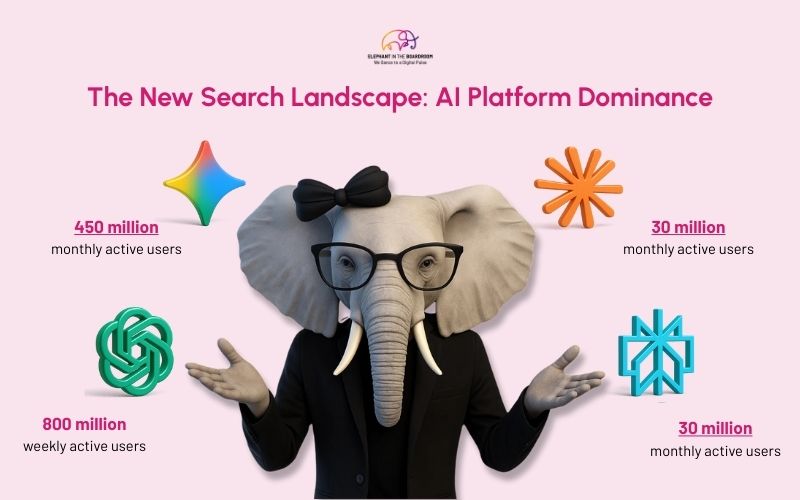
AI-powered answer engines are transforming how people find and consume information. Platforms like ChatGPT, Gemini, Claude 3.5, and Perplexity AI are no longer just tools—they are the next evolution of search, delivering precise answers instead of lists of links.
The numbers show their dominance:
- ChatGPT reaches 800 million weekly active users, making it one of the most frequently engaged AI systems globally.
- Gemini has climbed to over 450 million monthly active users, carving a significant space in the AI ecosystem.
- Claude 3.5 serves more than 30 million monthly users worldwide, reflecting a growing appetite for conversational intelligence.
- Perplexity AI also boasts roughly 30 million monthly users, demonstrating that niche platforms are still capturing meaningful engagement.
This rise of AI platforms has clear implications for content strategy:
- Platform-specific optimisation is critical- Each answer engine interprets and presents content differently.
- User intent is everything- Content must directly satisfy queries to be cited or recommended.
- Trust drives visibility- Accuracy, authority, and clarity determine whether an answer engine features your content.
In 2026, the brands that thrive will be those that understand these platforms at a granular level and craft content that isn’t just found, but actively recommended.
SEO in 2026: Optimising for Answer Engines in an AI-First World
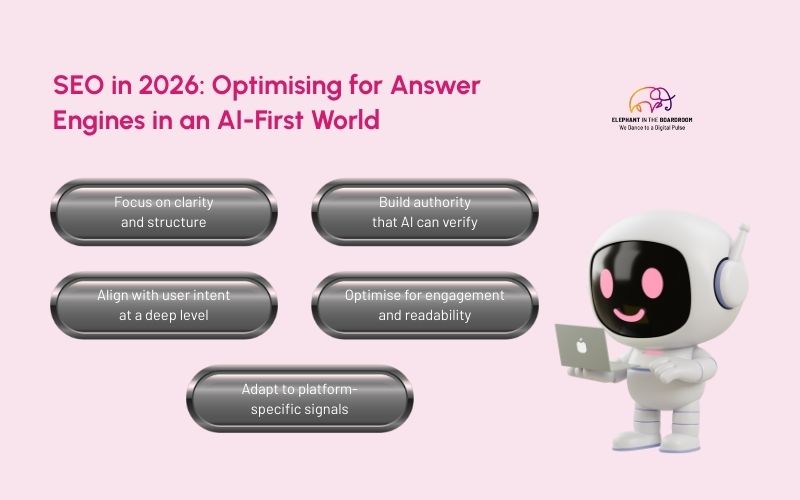
Some pages exist. Others get elevated. In 2026, the difference is whether AI considers your content the go-to answer. Here’s how you can optimise answer engines in an AI-first world to become that page:
Focus on Clarity and Structure
AI engines favour content they can easily understand and reference. Use clear headings, bullet points, numbered lists, and structured data. Well-organised content signals to AI that your page is a reliable, complete source of information, improving the likelihood of being cited or suggested.
Build Authority That AI Can Verify
SEO in 2026 rewards trust. Incorporate accurate data, expert insights, and credible references. Demonstrating knowledge and authority isn’t optional; it directly affects whether AI systems treat your content as a source worth recommending.
Align with User Intent at a Deep Level
Modern users ask precise, complex questions. Optimising for AI means delivering answers that satisfy these queries fully. Analyse the questions your audience is likely to ask and create content that addresses them comprehensively. AI engines favour content that anticipates follow-up questions and provides complete, actionable answers.
Optimise for Engagement and Readability
Even in an AI-first world, humans still interact with your content. SEO in 2026 works best when your content is digestible, visually organised, and easy to navigate. Short paragraphs, concise sentences, and clear explanations improve both user satisfaction and AI recommendation signals.
Adapt to Platform-Specific Signals
Different AI systems have different preferences. Some prioritise freshness, others favour depth or authority. Tailoring your content to the nuances of each platform ensures it performs optimally across multiple AI channels.
SEO in 2026: Take Control of Your AI-First Digital Future
As global experts in AI-first digital, we bring together website design, development, and marketing into one seamless strategy that positions your brand at the centre of the conversation. Every piece of content, every interaction, every click is designed to make your brand the authority people and AI trust.
Working with Elephant in the Boardroom means unlocking a partner who doesn’t just follow trends but anticipates them. We turn complexity into opportunity, helping you dominate search, capture attention, and create experiences that inspire action. Contact us and take the lead in the AI-first era.
Is traditional SEO dead because of AI? Not yet, but SEO in 2026 looks nothing like it did even a few years ago. The tactics that once guaranteed visibility are losing their power. Intelligent systems now decide what counts, rewarding clarity, authority, and content that actually answers questions. Brands stuck in the past risk fading into digital irrelevance, while those who adapt will see their content not just rank, but get cited and trusted by the AI engines shaping every user decision.
Businesses now have to think like AI, anticipating the questions users will ask and structuring content so it becomes the answer these systems rely on. Success isn’t measured in clicks or impressions anymore; it’s measured in relevance, authority, and the ability to be the content that AI chooses to recommend.
Keep reading to see how forward-thinking brands are rewriting their strategies, creating content designed to be indispensable, and taking control in a world where being the answer is the ultimate advantage.
What’s Inside:
- The New Search Landscape: AI Platform Dominance
- SEO in 2026: Optimising for Answer Engines in an AI-First World
- SEO in 2026: Take Control of Your AI-First Digital Future
The New Search Landscape: AI Platform Dominance
AI-powered answer engines are transforming how people find and consume information. Platforms like ChatGPT, Gemini, Claude 3.5, and Perplexity AI are no longer just tools—they are the next evolution of search, delivering precise answers instead of lists of links.
The numbers show their dominance:
- ChatGPT reaches 800 million weekly active users, making it one of the most frequently engaged AI systems globally.
- Gemini has climbed to over 450 million monthly active users, carving a significant space in the AI ecosystem.
- Claude 3.5 serves more than 30 million monthly users worldwide, reflecting a growing appetite for conversational intelligence.
- Perplexity AI also boasts roughly 30 million monthly users, demonstrating that niche platforms are still capturing meaningful engagement.
This rise of AI platforms has clear implications for content strategy:
- Platform-specific optimisation is critical- Each answer engine interprets and presents content differently.
- User intent is everything- Content must directly satisfy queries to be cited or recommended.
- Trust drives visibility- Accuracy, authority, and clarity determine whether an answer engine features your content.
In 2026, the brands that thrive will be those that understand these platforms at a granular level and craft content that isn’t just found, but actively recommended.
SEO in 2026: Optimising for Answer Engines in an AI-First World
Some pages exist. Others get elevated. In 2026, the difference is whether AI considers your content the go-to answer. Here’s how you can optimise answer engines in an AI-first world to become that page:
Focus on Clarity and Structure
AI engines favour content they can easily understand and reference. Use clear headings, bullet points, numbered lists, and structured data. Well-organised content signals to AI that your page is a reliable, complete source of information, improving the likelihood of being cited or suggested.
Build Authority That AI Can Verify
SEO in 2026 rewards trust. Incorporate accurate data, expert insights, and credible references. Demonstrating knowledge and authority isn’t optional; it directly affects whether AI systems treat your content as a source worth recommending.
Align with User Intent at a Deep Level
Modern users ask precise, complex questions. Optimising for AI means delivering answers that satisfy these queries fully. Analyse the questions your audience is likely to ask and create content that addresses them comprehensively. AI engines favour content that anticipates follow-up questions and provides complete, actionable answers.
Optimise for Engagement and Readability
Even in an AI-first world, humans still interact with your content. SEO in 2026 works best when your content is digestible, visually organised, and easy to navigate. Short paragraphs, concise sentences, and clear explanations improve both user satisfaction and AI recommendation signals.
Adapt to Platform-Specific Signals
Different AI systems have different preferences. Some prioritise freshness, others favour depth or authority. Tailoring your content to the nuances of each platform ensures it performs optimally across multiple AI channels.
SEO in 2026: Take Control of Your AI-First Digital Future
As global experts in AI-first digital, we bring together website design, development, and marketing into one seamless strategy that positions your brand at the centre of the conversation. Every piece of content, every interaction, every click is designed to make your brand the authority people and AI trust.
Working with Elephant in the Boardroom means unlocking a partner who doesn’t just follow trends but anticipates them. We turn complexity into opportunity, helping you dominate search, capture attention, and create experiences that inspire action. Contact us and take the lead in the AI-first era.
Is traditional SEO dead because of AI? Not yet, but SEO in 2026 looks nothing like it did even a few years ago. The tactics that once guaranteed visibility are losing their power. Intelligent systems now decide what counts, rewarding clarity, authority, and content that actually answers questions. Brands stuck in the past risk fading into digital irrelevance, while those who adapt will see their content not just rank, but get cited and trusted by the AI engines shaping every user decision.
Businesses now have to think like AI, anticipating the questions users will ask and structuring content so it becomes the answer these systems rely on. Success isn’t measured in clicks or impressions anymore; it’s measured in relevance, authority, and the ability to be the content that AI chooses to recommend.
Keep reading to see how forward-thinking brands are rewriting their strategies, creating content designed to be indispensable, and taking control in a world where being the answer is the ultimate advantage.
What’s Inside:
- The New Search Landscape: AI Platform Dominance
- SEO in 2026: Optimising for Answer Engines in an AI-First World
- SEO in 2026: Take Control of Your AI-First Digital Future
The New Search Landscape: AI Platform Dominance
AI-powered answer engines are transforming how people find and consume information. Platforms like ChatGPT, Gemini, Claude 3.5, and Perplexity AI are no longer just tools—they are the next evolution of search, delivering precise answers instead of lists of links.
The numbers show their dominance:
- ChatGPT reaches 800 million weekly active users, making it one of the most frequently engaged AI systems globally.
- Gemini has climbed to over 450 million monthly active users, carving a significant space in the AI ecosystem.
- Claude 3.5 serves more than 30 million monthly users worldwide, reflecting a growing appetite for conversational intelligence.
- Perplexity AI also boasts roughly 30 million monthly users, demonstrating that niche platforms are still capturing meaningful engagement.
This rise of AI platforms has clear implications for content strategy:
- Platform-specific optimisation is critical- Each answer engine interprets and presents content differently.
- User intent is everything- Content must directly satisfy queries to be cited or recommended.
- Trust drives visibility- Accuracy, authority, and clarity determine whether an answer engine features your content.
In 2026, the brands that thrive will be those that understand these platforms at a granular level and craft content that isn’t just found, but actively recommended.
SEO in 2026: Optimising for Answer Engines in an AI-First World
Some pages exist. Others get elevated. In 2026, the difference is whether AI considers your content the go-to answer. Here’s how you can optimise answer engines in an AI-first world to become that page:
Focus on Clarity and Structure
AI engines favour content they can easily understand and reference. Use clear headings, bullet points, numbered lists, and structured data. Well-organised content signals to AI that your page is a reliable, complete source of information, improving the likelihood of being cited or suggested.
Build Authority That AI Can Verify
SEO in 2026 rewards trust. Incorporate accurate data, expert insights, and credible references. Demonstrating knowledge and authority isn’t optional; it directly affects whether AI systems treat your content as a source worth recommending.
Align with User Intent at a Deep Level
Modern users ask precise, complex questions. Optimising for AI means delivering answers that satisfy these queries fully. Analyse the questions your audience is likely to ask and create content that addresses them comprehensively. AI engines favour content that anticipates follow-up questions and provides complete, actionable answers.
Optimise for Engagement and Readability
Even in an AI-first world, humans still interact with your content. SEO in 2026 works best when your content is digestible, visually organised, and easy to navigate. Short paragraphs, concise sentences, and clear explanations improve both user satisfaction and AI recommendation signals.
Adapt to Platform-Specific Signals
Different AI systems have different preferences. Some prioritise freshness, others favour depth or authority. Tailoring your content to the nuances of each platform ensures it performs optimally across multiple AI channels.
SEO in 2026: Take Control of Your AI-First Digital Future
As global experts in AI-first digital, we bring together website design, development, and marketing into one seamless strategy that positions your brand at the centre of the conversation. Every piece of content, every interaction, every click is designed to make your brand the authority people and AI trust.
Working with Elephant in the Boardroom means unlocking a partner who doesn’t just follow trends but anticipates them. We turn complexity into opportunity, helping you dominate search, capture attention, and create experiences that inspire action. Contact us and take the lead in the AI-first era.
Is traditional SEO dead because of AI? Not yet, but SEO in 2026 looks nothing like it did even a few years ago. The tactics that once guaranteed visibility are losing their power. Intelligent systems now decide what counts, rewarding clarity, authority, and content that actually answers questions. Brands stuck in the past risk fading into digital irrelevance, while those who adapt will see their content not just rank, but get cited and trusted by the AI engines shaping every user decision.
Businesses now have to think like AI, anticipating the questions users will ask and structuring content so it becomes the answer these systems rely on. Success isn’t measured in clicks or impressions anymore; it’s measured in relevance, authority, and the ability to be the content that AI chooses to recommend.
Keep reading to see how forward-thinking brands are rewriting their strategies, creating content designed to be indispensable, and taking control in a world where being the answer is the ultimate advantage.
What’s Inside:
- The New Search Landscape: AI Platform Dominance
- SEO in 2026: Optimising for Answer Engines in an AI-First World
- SEO in 2026: Take Control of Your AI-First Digital Future
The New Search Landscape: AI Platform Dominance
AI-powered answer engines are transforming how people find and consume information. Platforms like ChatGPT, Gemini, Claude 3.5, and Perplexity AI are no longer just tools—they are the next evolution of search, delivering precise answers instead of lists of links.
The numbers show their dominance:
- ChatGPT reaches 800 million weekly active users, making it one of the most frequently engaged AI systems globally.
- Gemini has climbed to over 450 million monthly active users, carving a significant space in the AI ecosystem.
- Claude 3.5 serves more than 30 million monthly users worldwide, reflecting a growing appetite for conversational intelligence.
- Perplexity AI also boasts roughly 30 million monthly users, demonstrating that niche platforms are still capturing meaningful engagement.
This rise of AI platforms has clear implications for content strategy:
- Platform-specific optimisation is critical- Each answer engine interprets and presents content differently.
- User intent is everything- Content must directly satisfy queries to be cited or recommended.
- Trust drives visibility- Accuracy, authority, and clarity determine whether an answer engine features your content.
In 2026, the brands that thrive will be those that understand these platforms at a granular level and craft content that isn’t just found, but actively recommended.
SEO in 2026: Optimising for Answer Engines in an AI-First World
Some pages exist. Others get elevated. In 2026, the difference is whether AI considers your content the go-to answer. Here’s how you can optimise answer engines in an AI-first world to become that page:
Focus on Clarity and Structure
AI engines favour content they can easily understand and reference. Use clear headings, bullet points, numbered lists, and structured data. Well-organised content signals to AI that your page is a reliable, complete source of information, improving the likelihood of being cited or suggested.
Build Authority That AI Can Verify
SEO in 2026 rewards trust. Incorporate accurate data, expert insights, and credible references. Demonstrating knowledge and authority isn’t optional; it directly affects whether AI systems treat your content as a source worth recommending.
Align with User Intent at a Deep Level
Modern users ask precise, complex questions. Optimising for AI means delivering answers that satisfy these queries fully. Analyse the questions your audience is likely to ask and create content that addresses them comprehensively. AI engines favour content that anticipates follow-up questions and provides complete, actionable answers.
Optimise for Engagement and Readability
Even in an AI-first world, humans still interact with your content. SEO in 2026 works best when your content is digestible, visually organised, and easy to navigate. Short paragraphs, concise sentences, and clear explanations improve both user satisfaction and AI recommendation signals.
Adapt to Platform-Specific Signals
Different AI systems have different preferences. Some prioritise freshness, others favour depth or authority. Tailoring your content to the nuances of each platform ensures it performs optimally across multiple AI channels.
SEO in 2026: Take Control of Your AI-First Digital Future
As global experts in AI-first digital, we bring together website design, development, and marketing into one seamless strategy that positions your brand at the centre of the conversation. Every piece of content, every interaction, every click is designed to make your brand the authority people and AI trust.
Working with Elephant in the Boardroom means unlocking a partner who doesn’t just follow trends but anticipates them. We turn complexity into opportunity, helping you dominate search, capture attention, and create experiences that inspire action. Contact us and take the lead in the AI-first era.
Is traditional SEO dead because of AI? Not yet, but SEO in 2026 looks nothing like it did even a few years ago. The tactics that once guaranteed visibility are losing their power. Intelligent systems now decide what counts, rewarding clarity, authority, and content that actually answers questions. Brands stuck in the past risk fading into digital irrelevance, while those who adapt will see their content not just rank, but get cited and trusted by the AI engines shaping every user decision.
Businesses now have to think like AI, anticipating the questions users will ask and structuring content so it becomes the answer these systems rely on. Success isn’t measured in clicks or impressions anymore; it’s measured in relevance, authority, and the ability to be the content that AI chooses to recommend.
Keep reading to see how forward-thinking brands are rewriting their strategies, creating content designed to be indispensable, and taking control in a world where being the answer is the ultimate advantage.
What’s Inside:
- The New Search Landscape: AI Platform Dominance
- SEO in 2026: Optimising for Answer Engines in an AI-First World
- SEO in 2026: Take Control of Your AI-First Digital Future
The New Search Landscape: AI Platform Dominance
AI-powered answer engines are transforming how people find and consume information. Platforms like ChatGPT, Gemini, Claude 3.5, and Perplexity AI are no longer just tools—they are the next evolution of search, delivering precise answers instead of lists of links.
The numbers show their dominance:
- ChatGPT reaches 800 million weekly active users, making it one of the most frequently engaged AI systems globally.
- Gemini has climbed to over 450 million monthly active users, carving a significant space in the AI ecosystem.
- Claude 3.5 serves more than 30 million monthly users worldwide, reflecting a growing appetite for conversational intelligence.
- Perplexity AI also boasts roughly 30 million monthly users, demonstrating that niche platforms are still capturing meaningful engagement.
This rise of AI platforms has clear implications for content strategy:
- Platform-specific optimisation is critical- Each answer engine interprets and presents content differently.
- User intent is everything- Content must directly satisfy queries to be cited or recommended.
- Trust drives visibility- Accuracy, authority, and clarity determine whether an answer engine features your content.
In 2026, the brands that thrive will be those that understand these platforms at a granular level and craft content that isn’t just found, but actively recommended.
SEO in 2026: Optimising for Answer Engines in an AI-First World
Some pages exist. Others get elevated. In 2026, the difference is whether AI considers your content the go-to answer. Here’s how you can optimise answer engines in an AI-first world to become that page:
Focus on Clarity and Structure
AI engines favour content they can easily understand and reference. Use clear headings, bullet points, numbered lists, and structured data. Well-organised content signals to AI that your page is a reliable, complete source of information, improving the likelihood of being cited or suggested.
Build Authority That AI Can Verify
SEO in 2026 rewards trust. Incorporate accurate data, expert insights, and credible references. Demonstrating knowledge and authority isn’t optional; it directly affects whether AI systems treat your content as a source worth recommending.
Align with User Intent at a Deep Level
Modern users ask precise, complex questions. Optimising for AI means delivering answers that satisfy these queries fully. Analyse the questions your audience is likely to ask and create content that addresses them comprehensively. AI engines favour content that anticipates follow-up questions and provides complete, actionable answers.
Optimise for Engagement and Readability
Even in an AI-first world, humans still interact with your content. SEO in 2026 works best when your content is digestible, visually organised, and easy to navigate. Short paragraphs, concise sentences, and clear explanations improve both user satisfaction and AI recommendation signals.
Adapt to Platform-Specific Signals
Different AI systems have different preferences. Some prioritise freshness, others favour depth or authority. Tailoring your content to the nuances of each platform ensures it performs optimally across multiple AI channels.
SEO in 2026: Take Control of Your AI-First Digital Future
As global experts in AI-first digital, we bring together website design, development, and marketing into one seamless strategy that positions your brand at the centre of the conversation. Every piece of content, every interaction, every click is designed to make your brand the authority people and AI trust.
Working with Elephant in the Boardroom means unlocking a partner who doesn’t just follow trends but anticipates them. We turn complexity into opportunity, helping you dominate search, capture attention, and create experiences that inspire action. Contact us and take the lead in the AI-first era.

SEO has always been a game of cat and mouse. Marketers chase visibility, search engines change the rules, and the hunt never really ends. But now the cat’s evolved. It can write, predict, and serve answers before the mouse even moves. Generative search has flipped the chase entirely. With over 115 to 180 million people using AI tools every day, the web is no longer a playground of keywords and backlinks, it is now a living, learning ecosystem where AI decides what deserves attention.
So what happens to the mouse? It keeps running, but only with sharper instincts. The tactics that once guaranteed a spot on page one are fading into the background as AI takes control of the spotlight. If your SEO stack can’t handle the new terrain, the chase might be over before you notice. Keep reading to stay in the game while the cat learns new tricks.
What’s Inside:
- Understanding Generative Search and Its Impact on SEO
- Is Your SEO Stack Ready? A Generative Search Checklist
- Unlock Growth with AI-Driven SEO Expertise
Understanding Generative Search and Its Impact on SEO
Generative search represents a fundamental evolution in how people find information online. Powered by large language models (LLMs), these search experiences go beyond returning lists of links, they generate contextual, on-the-fly answers tailored to the user’s query. Examples include Google’s AI Overviews and conversational search models such as Gemini or ChatGPT with browsing capabilities.
This shift is reshaping the SEO landscape in profound ways:
- Search behaviour becomes conversational- Users now engage with search engines using natural, nuanced language. They expect answers that are contextually relevant, precise, and directly actionable, far beyond the generic lists of links that dominated traditional search.
- Fewer clicks to websites- When search engines generate comprehensive answers, users may no longer need to visit multiple pages.
- Greater content exploration- AI models prioritise authoritative, well-structured, and original content. Weak, duplicated, or poorly cited material risks being overlooked entirely.
- Entity-driven discovery- Generative search engines increasingly organise information around entities, like brands, products, people, or locations. The clarity, accuracy, and interconnectivity of how these entities are represented across the web directly impact visibility in AI-generated answers.
- Real expertise gains priority- Search engines assess not just the content itself, but who created it and whether it can be trusted as a reliable source. Authority and transparency now carry measurable weight in discoverability.
What does this mean for your SEO strategy?
Success in the era of generative search goes beyond ranking on page one. It is about becoming a trusted source that AI tools reference, cite, and surface. Achieving this requires:
- Strategic, high-value content that demonstrates expertise and authority.
- Robust technical foundations ensure that content is easily discoverable and clearly structured.
- A verifiable brand presence that search engines can confidently identify, understand, and trust.
In short, SEO is evolving from a game of rankings to a game of trust, relevance, and authoritative visibility. Brands that adapt now will not just survive the AI-powered search era, they will lead it.
Is Your SEO Stack Ready? A Generative Search Checklist
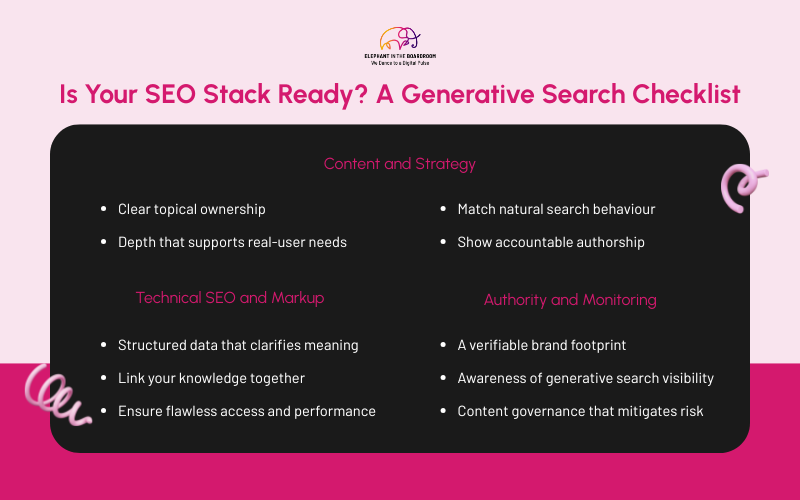
Use the checklist below to assess whether you are genuinely set up for an environment where AI-driven responses shape how users discover and evaluate brands.
Content and Strategy
Clear Topical Ownership
You need a defined content universe that aligns with the subjects your brand should be known for. Generative models learn from patterns. If your content is scattered or inconsistent in tone, expertise, or depth, those patterns dilute your authority. Inconsistent in tone and expertise, those signals weaken your visibility.
Depth that Supports Real-user Needs
AI doesn’t reward surface-level writing. Produce content that demonstrates first-hand knowledge, detailed reasoning, and reliable sourcing. Each piece should prove why your brand deserves to be referenced as a trusted source.
Match Natural Search Behaviour
Queries are now conversational and task-driven. Content should anticipate how real people ask questions and include the context that clarifies intent, without relying on artificial keyword tactics.
Show Accountable Authorship
Every major piece clearly shows who wrote it and why they are qualified. Author pages, citations, and transparent sourcing strengthen trust signals that LLMs rely on.
Technical SEO and Markup
Structured Data that Clarifies Meaning
Schema and markup give AI systems a map of your entities, relationships, and content hierarchy. Correct implementation ensures your site is interpreted as a reliable knowledge source rather than a collection of unconnected pages.
Link Your Knowledge Together
Internal linking and categorisation should clearly indicate how your topics connect. Generative models reward structured, easily navigable sites where relationships between content are obvious.
Ensure Flawless Access and Performance
Generative systems value content they can parse and trust quickly. If your pages are slow, cluttered, or inaccessible, you add friction where clarity is needed. Valid code, accessible design, and mobile responsiveness all contribute to stronger signals.
Authority and Monitoring
A Verifiable Brand Footprint
Your brand should have clear digital proof of expertise: real authors, mentions, citations, industry involvement, and credible third-party references. These external signals are increasingly weighted in generative evaluations.
Awareness of Generative Search Visibility
Track how your content and brand appear in AI-generated summaries, answers, or comparisons. Visibility in these outputs indicates whether your authority is being recognised.
Content Governance that Mitigates Risk
If your content includes unsupported claims, outdated data, or vague positioning, it can harm how your brand is evaluated. A quality assurance framework ensures every piece strengthens your authority.
Unlock Growth with AI-Driven SEO Expertise
Your customers are already discovering brands through AI-generated results, so it is time to put your digital presence in expert hands. Elephant in the Boardroom propels organisations into the AI era with SEO built for generative search. We fuse strategy, creativity, and world-class tech to lift you ahead of competitors still relying on yesterday’s tactics.
Let’s accelerate your growth with solutions that meet search engines where they’re heading. Chat with the global experts in AI-first digital solutions at Elephant in the Boardroom and unleash performance that pushes your brand higher, faster, stronger. Your next big win could start today.
SEO has always been a game of cat and mouse. Marketers chase visibility, search engines change the rules, and the hunt never really ends. But now the cat’s evolved. It can write, predict, and serve answers before the mouse even moves. Generative search has flipped the chase entirely. With over 115 to 180 million people using AI tools every day, the web is no longer a playground of keywords and backlinks, it is now a living, learning ecosystem where AI decides what deserves attention.
So what happens to the mouse? It keeps running, but only with sharper instincts. The tactics that once guaranteed a spot on page one are fading into the background as AI takes control of the spotlight. If your SEO stack can’t handle the new terrain, the chase might be over before you notice. Keep reading to stay in the game while the cat learns new tricks.
What’s Inside:
- Understanding Generative Search and Its Impact on SEO
- Is Your SEO Stack Ready? A Generative Search Checklist
- Unlock Growth with AI-Driven SEO Expertise
Understanding Generative Search and Its Impact on SEO
Generative search represents a fundamental evolution in how people find information online. Powered by large language models (LLMs), these search experiences go beyond returning lists of links, they generate contextual, on-the-fly answers tailored to the user’s query. Examples include Google’s AI Overviews and conversational search models such as Gemini or ChatGPT with browsing capabilities.
This shift is reshaping the SEO landscape in profound ways:
- Search behaviour becomes conversational- Users now engage with search engines using natural, nuanced language. They expect answers that are contextually relevant, precise, and directly actionable, far beyond the generic lists of links that dominated traditional search.
- Fewer clicks to websites- When search engines generate comprehensive answers, users may no longer need to visit multiple pages.
- Greater content exploration- AI models prioritise authoritative, well-structured, and original content. Weak, duplicated, or poorly cited material risks being overlooked entirely.
- Entity-driven discovery- Generative search engines increasingly organise information around entities, like brands, products, people, or locations. The clarity, accuracy, and interconnectivity of how these entities are represented across the web directly impact visibility in AI-generated answers.
- Real expertise gains priority- Search engines assess not just the content itself, but who created it and whether it can be trusted as a reliable source. Authority and transparency now carry measurable weight in discoverability.
What does this mean for your SEO strategy?
Success in the era of generative search goes beyond ranking on page one. It is about becoming a trusted source that AI tools reference, cite, and surface. Achieving this requires:
- Strategic, high-value content that demonstrates expertise and authority.
- Robust technical foundations ensure that content is easily discoverable and clearly structured.
- A verifiable brand presence that search engines can confidently identify, understand, and trust.
In short, SEO is evolving from a game of rankings to a game of trust, relevance, and authoritative visibility. Brands that adapt now will not just survive the AI-powered search era, they will lead it.
Is Your SEO Stack Ready? A Generative Search Checklist
Use the checklist below to assess whether you are genuinely set up for an environment where AI-driven responses shape how users discover and evaluate brands.
Content and Strategy
Clear Topical Ownership
You need a defined content universe that aligns with the subjects your brand should be known for. Generative models learn from patterns. If your content is scattered or inconsistent in tone, expertise, or depth, those patterns dilute your authority. Inconsistent in tone and expertise, those signals weaken your visibility.
Depth that Supports Real-user Needs
AI doesn’t reward surface-level writing. Produce content that demonstrates first-hand knowledge, detailed reasoning, and reliable sourcing. Each piece should prove why your brand deserves to be referenced as a trusted source.
Match Natural Search Behaviour
Queries are now conversational and task-driven. Content should anticipate how real people ask questions and include the context that clarifies intent, without relying on artificial keyword tactics.
Show Accountable Authorship
Every major piece clearly shows who wrote it and why they are qualified. Author pages, citations, and transparent sourcing strengthen trust signals that LLMs rely on.
Technical SEO and Markup
Structured Data that Clarifies Meaning
Schema and markup give AI systems a map of your entities, relationships, and content hierarchy. Correct implementation ensures your site is interpreted as a reliable knowledge source rather than a collection of unconnected pages.
Link Your Knowledge Together
Internal linking and categorisation should clearly indicate how your topics connect. Generative models reward structured, easily navigable sites where relationships between content are obvious.
Ensure Flawless Access and Performance
Generative systems value content they can parse and trust quickly. If your pages are slow, cluttered, or inaccessible, you add friction where clarity is needed. Valid code, accessible design, and mobile responsiveness all contribute to stronger signals.
Authority and Monitoring
A Verifiable Brand Footprint
Your brand should have clear digital proof of expertise: real authors, mentions, citations, industry involvement, and credible third-party references. These external signals are increasingly weighted in generative evaluations.
Awareness of Generative Search Visibility
Track how your content and brand appear in AI-generated summaries, answers, or comparisons. Visibility in these outputs indicates whether your authority is being recognised.
Content Governance that Mitigates Risk
If your content includes unsupported claims, outdated data, or vague positioning, it can harm how your brand is evaluated. A quality assurance framework ensures every piece strengthens your authority.
Unlock Growth with AI-Driven SEO Expertise
Your customers are already discovering brands through AI-generated results, so it is time to put your digital presence in expert hands. Elephant in the Boardroom propels organisations into the AI era with SEO built for generative search. We fuse strategy, creativity, and world-class tech to lift you ahead of competitors still relying on yesterday’s tactics.
Let’s accelerate your growth with solutions that meet search engines where they’re heading. Chat with the global experts in AI-first digital solutions at Elephant in the Boardroom and unleash performance that pushes your brand higher, faster, stronger. Your next big win could start today.
SEO has always been a game of cat and mouse. Marketers chase visibility, search engines change the rules, and the hunt never really ends. But now the cat’s evolved. It can write, predict, and serve answers before the mouse even moves. Generative search has flipped the chase entirely. With over 115 to 180 million people using AI tools every day, the web is no longer a playground of keywords and backlinks, it is now a living, learning ecosystem where AI decides what deserves attention.
So what happens to the mouse? It keeps running, but only with sharper instincts. The tactics that once guaranteed a spot on page one are fading into the background as AI takes control of the spotlight. If your SEO stack can’t handle the new terrain, the chase might be over before you notice. Keep reading to stay in the game while the cat learns new tricks.
What’s Inside:
- Understanding Generative Search and Its Impact on SEO
- Is Your SEO Stack Ready? A Generative Search Checklist
- Unlock Growth with AI-Driven SEO Expertise
Understanding Generative Search and Its Impact on SEO
Generative search represents a fundamental evolution in how people find information online. Powered by large language models (LLMs), these search experiences go beyond returning lists of links, they generate contextual, on-the-fly answers tailored to the user’s query. Examples include Google’s AI Overviews and conversational search models such as Gemini or ChatGPT with browsing capabilities.
This shift is reshaping the SEO landscape in profound ways:
- Search behaviour becomes conversational- Users now engage with search engines using natural, nuanced language. They expect answers that are contextually relevant, precise, and directly actionable, far beyond the generic lists of links that dominated traditional search.
- Fewer clicks to websites- When search engines generate comprehensive answers, users may no longer need to visit multiple pages.
- Greater content exploration- AI models prioritise authoritative, well-structured, and original content. Weak, duplicated, or poorly cited material risks being overlooked entirely.
- Entity-driven discovery- Generative search engines increasingly organise information around entities, like brands, products, people, or locations. The clarity, accuracy, and interconnectivity of how these entities are represented across the web directly impact visibility in AI-generated answers.
- Real expertise gains priority- Search engines assess not just the content itself, but who created it and whether it can be trusted as a reliable source. Authority and transparency now carry measurable weight in discoverability.
What does this mean for your SEO strategy?
Success in the era of generative search goes beyond ranking on page one. It is about becoming a trusted source that AI tools reference, cite, and surface. Achieving this requires:
- Strategic, high-value content that demonstrates expertise and authority.
- Robust technical foundations ensure that content is easily discoverable and clearly structured.
- A verifiable brand presence that search engines can confidently identify, understand, and trust.
In short, SEO is evolving from a game of rankings to a game of trust, relevance, and authoritative visibility. Brands that adapt now will not just survive the AI-powered search era, they will lead it.
Is Your SEO Stack Ready? A Generative Search Checklist
Use the checklist below to assess whether you are genuinely set up for an environment where AI-driven responses shape how users discover and evaluate brands.
Content and Strategy
Clear Topical Ownership
You need a defined content universe that aligns with the subjects your brand should be known for. Generative models learn from patterns. If your content is scattered or inconsistent in tone, expertise, or depth, those patterns dilute your authority. Inconsistent in tone and expertise, those signals weaken your visibility.
Depth that Supports Real-user Needs
AI doesn’t reward surface-level writing. Produce content that demonstrates first-hand knowledge, detailed reasoning, and reliable sourcing. Each piece should prove why your brand deserves to be referenced as a trusted source.
Match Natural Search Behaviour
Queries are now conversational and task-driven. Content should anticipate how real people ask questions and include the context that clarifies intent, without relying on artificial keyword tactics.
Show Accountable Authorship
Every major piece clearly shows who wrote it and why they are qualified. Author pages, citations, and transparent sourcing strengthen trust signals that LLMs rely on.
Technical SEO and Markup
Structured Data that Clarifies Meaning
Schema and markup give AI systems a map of your entities, relationships, and content hierarchy. Correct implementation ensures your site is interpreted as a reliable knowledge source rather than a collection of unconnected pages.
Link Your Knowledge Together
Internal linking and categorisation should clearly indicate how your topics connect. Generative models reward structured, easily navigable sites where relationships between content are obvious.
Ensure Flawless Access and Performance
Generative systems value content they can parse and trust quickly. If your pages are slow, cluttered, or inaccessible, you add friction where clarity is needed. Valid code, accessible design, and mobile responsiveness all contribute to stronger signals.
Authority and Monitoring
A Verifiable Brand Footprint
Your brand should have clear digital proof of expertise: real authors, mentions, citations, industry involvement, and credible third-party references. These external signals are increasingly weighted in generative evaluations.
Awareness of Generative Search Visibility
Track how your content and brand appear in AI-generated summaries, answers, or comparisons. Visibility in these outputs indicates whether your authority is being recognised.
Content Governance that Mitigates Risk
If your content includes unsupported claims, outdated data, or vague positioning, it can harm how your brand is evaluated. A quality assurance framework ensures every piece strengthens your authority.
Unlock Growth with AI-Driven SEO Expertise
Your customers are already discovering brands through AI-generated results, so it is time to put your digital presence in expert hands. Elephant in the Boardroom propels organisations into the AI era with SEO built for generative search. We fuse strategy, creativity, and world-class tech to lift you ahead of competitors still relying on yesterday’s tactics.
Let’s accelerate your growth with solutions that meet search engines where they’re heading. Chat with the global experts in AI-first digital solutions at Elephant in the Boardroom and unleash performance that pushes your brand higher, faster, stronger. Your next big win could start today.
SEO has always been a game of cat and mouse. Marketers chase visibility, search engines change the rules, and the hunt never really ends. But now the cat’s evolved. It can write, predict, and serve answers before the mouse even moves. Generative search has flipped the chase entirely. With over 115 to 180 million people using AI tools every day, the web is no longer a playground of keywords and backlinks, it is now a living, learning ecosystem where AI decides what deserves attention.
So what happens to the mouse? It keeps running, but only with sharper instincts. The tactics that once guaranteed a spot on page one are fading into the background as AI takes control of the spotlight. If your SEO stack can’t handle the new terrain, the chase might be over before you notice. Keep reading to stay in the game while the cat learns new tricks.
What’s Inside:
- Understanding Generative Search and Its Impact on SEO
- Is Your SEO Stack Ready? A Generative Search Checklist
- Unlock Growth with AI-Driven SEO Expertise
Understanding Generative Search and Its Impact on SEO
Generative search represents a fundamental evolution in how people find information online. Powered by large language models (LLMs), these search experiences go beyond returning lists of links, they generate contextual, on-the-fly answers tailored to the user’s query. Examples include Google’s AI Overviews and conversational search models such as Gemini or ChatGPT with browsing capabilities.
This shift is reshaping the SEO landscape in profound ways:
- Search behaviour becomes conversational- Users now engage with search engines using natural, nuanced language. They expect answers that are contextually relevant, precise, and directly actionable, far beyond the generic lists of links that dominated traditional search.
- Fewer clicks to websites- When search engines generate comprehensive answers, users may no longer need to visit multiple pages.
- Greater content exploration- AI models prioritise authoritative, well-structured, and original content. Weak, duplicated, or poorly cited material risks being overlooked entirely.
- Entity-driven discovery- Generative search engines increasingly organise information around entities, like brands, products, people, or locations. The clarity, accuracy, and interconnectivity of how these entities are represented across the web directly impact visibility in AI-generated answers.
- Real expertise gains priority- Search engines assess not just the content itself, but who created it and whether it can be trusted as a reliable source. Authority and transparency now carry measurable weight in discoverability.
What does this mean for your SEO strategy?
Success in the era of generative search goes beyond ranking on page one. It is about becoming a trusted source that AI tools reference, cite, and surface. Achieving this requires:
- Strategic, high-value content that demonstrates expertise and authority.
- Robust technical foundations ensure that content is easily discoverable and clearly structured.
- A verifiable brand presence that search engines can confidently identify, understand, and trust.
In short, SEO is evolving from a game of rankings to a game of trust, relevance, and authoritative visibility. Brands that adapt now will not just survive the AI-powered search era, they will lead it.
Is Your SEO Stack Ready? A Generative Search Checklist
Use the checklist below to assess whether you are genuinely set up for an environment where AI-driven responses shape how users discover and evaluate brands.
Content and Strategy
Clear Topical Ownership
You need a defined content universe that aligns with the subjects your brand should be known for. Generative models learn from patterns. If your content is scattered or inconsistent in tone, expertise, or depth, those patterns dilute your authority. Inconsistent in tone and expertise, those signals weaken your visibility.
Depth that Supports Real-user Needs
AI doesn’t reward surface-level writing. Produce content that demonstrates first-hand knowledge, detailed reasoning, and reliable sourcing. Each piece should prove why your brand deserves to be referenced as a trusted source.
Match Natural Search Behaviour
Queries are now conversational and task-driven. Content should anticipate how real people ask questions and include the context that clarifies intent, without relying on artificial keyword tactics.
Show Accountable Authorship
Every major piece clearly shows who wrote it and why they are qualified. Author pages, citations, and transparent sourcing strengthen trust signals that LLMs rely on.
Technical SEO and Markup
Structured Data that Clarifies Meaning
Schema and markup give AI systems a map of your entities, relationships, and content hierarchy. Correct implementation ensures your site is interpreted as a reliable knowledge source rather than a collection of unconnected pages.
Link Your Knowledge Together
Internal linking and categorisation should clearly indicate how your topics connect. Generative models reward structured, easily navigable sites where relationships between content are obvious.
Ensure Flawless Access and Performance
Generative systems value content they can parse and trust quickly. If your pages are slow, cluttered, or inaccessible, you add friction where clarity is needed. Valid code, accessible design, and mobile responsiveness all contribute to stronger signals.
Authority and Monitoring
A Verifiable Brand Footprint
Your brand should have clear digital proof of expertise: real authors, mentions, citations, industry involvement, and credible third-party references. These external signals are increasingly weighted in generative evaluations.
Awareness of Generative Search Visibility
Track how your content and brand appear in AI-generated summaries, answers, or comparisons. Visibility in these outputs indicates whether your authority is being recognised.
Content Governance that Mitigates Risk
If your content includes unsupported claims, outdated data, or vague positioning, it can harm how your brand is evaluated. A quality assurance framework ensures every piece strengthens your authority.
Unlock Growth with AI-Driven SEO Expertise
Your customers are already discovering brands through AI-generated results, so it is time to put your digital presence in expert hands. Elephant in the Boardroom propels organisations into the AI era with SEO built for generative search. We fuse strategy, creativity, and world-class tech to lift you ahead of competitors still relying on yesterday’s tactics.
Let’s accelerate your growth with solutions that meet search engines where they’re heading. Chat with the global experts in AI-first digital solutions at Elephant in the Boardroom and unleash performance that pushes your brand higher, faster, stronger. Your next big win could start today.
SEO has always been a game of cat and mouse. Marketers chase visibility, search engines change the rules, and the hunt never really ends. But now the cat’s evolved. It can write, predict, and serve answers before the mouse even moves. Generative search has flipped the chase entirely. With over 115 to 180 million people using AI tools every day, the web is no longer a playground of keywords and backlinks, it is now a living, learning ecosystem where AI decides what deserves attention.
So what happens to the mouse? It keeps running, but only with sharper instincts. The tactics that once guaranteed a spot on page one are fading into the background as AI takes control of the spotlight. If your SEO stack can’t handle the new terrain, the chase might be over before you notice. Keep reading to stay in the game while the cat learns new tricks.
What’s Inside:
- Understanding Generative Search and Its Impact on SEO
- Is Your SEO Stack Ready? A Generative Search Checklist
- Unlock Growth with AI-Driven SEO Expertise
Understanding Generative Search and Its Impact on SEO
Generative search represents a fundamental evolution in how people find information online. Powered by large language models (LLMs), these search experiences go beyond returning lists of links, they generate contextual, on-the-fly answers tailored to the user’s query. Examples include Google’s AI Overviews and conversational search models such as Gemini or ChatGPT with browsing capabilities.
This shift is reshaping the SEO landscape in profound ways:
- Search behaviour becomes conversational- Users now engage with search engines using natural, nuanced language. They expect answers that are contextually relevant, precise, and directly actionable, far beyond the generic lists of links that dominated traditional search.
- Fewer clicks to websites- When search engines generate comprehensive answers, users may no longer need to visit multiple pages.
- Greater content exploration- AI models prioritise authoritative, well-structured, and original content. Weak, duplicated, or poorly cited material risks being overlooked entirely.
- Entity-driven discovery- Generative search engines increasingly organise information around entities, like brands, products, people, or locations. The clarity, accuracy, and interconnectivity of how these entities are represented across the web directly impact visibility in AI-generated answers.
- Real expertise gains priority- Search engines assess not just the content itself, but who created it and whether it can be trusted as a reliable source. Authority and transparency now carry measurable weight in discoverability.
What does this mean for your SEO strategy?
Success in the era of generative search goes beyond ranking on page one. It is about becoming a trusted source that AI tools reference, cite, and surface. Achieving this requires:
- Strategic, high-value content that demonstrates expertise and authority.
- Robust technical foundations ensure that content is easily discoverable and clearly structured.
- A verifiable brand presence that search engines can confidently identify, understand, and trust.
In short, SEO is evolving from a game of rankings to a game of trust, relevance, and authoritative visibility. Brands that adapt now will not just survive the AI-powered search era, they will lead it.
Is Your SEO Stack Ready? A Generative Search Checklist
Use the checklist below to assess whether you are genuinely set up for an environment where AI-driven responses shape how users discover and evaluate brands.
Content and Strategy
Clear Topical Ownership
You need a defined content universe that aligns with the subjects your brand should be known for. Generative models learn from patterns. If your content is scattered or inconsistent in tone, expertise, or depth, those patterns dilute your authority. Inconsistent in tone and expertise, those signals weaken your visibility.
Depth that Supports Real-user Needs
AI doesn’t reward surface-level writing. Produce content that demonstrates first-hand knowledge, detailed reasoning, and reliable sourcing. Each piece should prove why your brand deserves to be referenced as a trusted source.
Match Natural Search Behaviour
Queries are now conversational and task-driven. Content should anticipate how real people ask questions and include the context that clarifies intent, without relying on artificial keyword tactics.
Show Accountable Authorship
Every major piece clearly shows who wrote it and why they are qualified. Author pages, citations, and transparent sourcing strengthen trust signals that LLMs rely on.
Technical SEO and Markup
Structured Data that Clarifies Meaning
Schema and markup give AI systems a map of your entities, relationships, and content hierarchy. Correct implementation ensures your site is interpreted as a reliable knowledge source rather than a collection of unconnected pages.
Link Your Knowledge Together
Internal linking and categorisation should clearly indicate how your topics connect. Generative models reward structured, easily navigable sites where relationships between content are obvious.
Ensure Flawless Access and Performance
Generative systems value content they can parse and trust quickly. If your pages are slow, cluttered, or inaccessible, you add friction where clarity is needed. Valid code, accessible design, and mobile responsiveness all contribute to stronger signals.
Authority and Monitoring
A Verifiable Brand Footprint
Your brand should have clear digital proof of expertise: real authors, mentions, citations, industry involvement, and credible third-party references. These external signals are increasingly weighted in generative evaluations.
Awareness of Generative Search Visibility
Track how your content and brand appear in AI-generated summaries, answers, or comparisons. Visibility in these outputs indicates whether your authority is being recognised.
Content Governance that Mitigates Risk
If your content includes unsupported claims, outdated data, or vague positioning, it can harm how your brand is evaluated. A quality assurance framework ensures every piece strengthens your authority.
Unlock Growth with AI-Driven SEO Expertise
Your customers are already discovering brands through AI-generated results, so it is time to put your digital presence in expert hands. Elephant in the Boardroom propels organisations into the AI era with SEO built for generative search. We fuse strategy, creativity, and world-class tech to lift you ahead of competitors still relying on yesterday’s tactics.
Let’s accelerate your growth with solutions that meet search engines where they’re heading. Chat with the global experts in AI-first digital solutions at Elephant in the Boardroom and unleash performance that pushes your brand higher, faster, stronger. Your next big win could start today.






4.4 rating from 30 Google reviews