
Your feed is already giving it away - SEO is not what it used to be. We have entered a new era where voice search answers you before you even finish asking, video content runs the internet, and semantic search optimisation knows exactly what you meant, even if you did not say it right. The future of SEO is not waiting for you to catch up. It is already moving, fast. So, are you still playing catch-up with 2020 tactics?
This is not about stuffing keywords anymore, it is about mastering voice search, dominating video content, and cracking the code of semantic search optimisation. The future of SEO is already rewriting the rules. Scroll on, and we will show you how to stay in the game and ahead of it.
What’s Inside:
- Where We Stand Today: The State of SEO in 2025
- The Changing Face of Search: What’s Driving the Shift?
- Preparing for the Future of SEO: Voice Search, Video Content, and Semantic Search Optimisation
- Lead the Future of SEO with Elephant in the Boardroom
Where We Stand Today: The State of SEO in 2025
Back in 2015, it was all about keyword stuffing, backlinks, and desktop optimisation. Fast forward to 2024, and we saw the rise of mobile-first indexing, the importance of user experience, and the integration of AI into search algorithms. Now, in 2025, SEO has evolved into a more sophisticated and user-centric discipline, especially here in Australia. The industry is projected to be valued at $2.5 billion, reflecting a significant growth from $2.1 billion in 2024.
Source: blog.applabx.com
Over half of Australians now use voice search regularly, with 33% engaging in daily voice queries, especially for local information. This trend has prompted businesses to adapt by focusing on conversational content and optimising for long-tail, question-based keywords. Moreover, Google's AI-powered Search Generative Experience (SGE) is redefining search interactions by delivering more intuitive and context-rich results.
The Changing Face of Search: What Is Driving the Shift?

Just when you think you got it all figured out, Google drops another update or a new trend takes off. But there is a good reason for it, actually, a few. SEO keeps changing because search itself is always evolving. And that is driven by three big forces:
People Change the Way They Search
The way people use search engines isn’t the same as it was five years ago, or even last year. We have gone from typing in clunky keywords to asking full questions, using voice commands, and expecting instant answers. As user behaviour shifts, search engines have to adapt to meet those expectations. That means SEO has to shift too, focusing more on intent, context, and natural language.
Google Wants to Improve the Experience
Search engines aren’t changing the rules just to keep marketers on their toes, they are doing it to make results better for users. Every algorithm update is designed to weed out spammy, irrelevant, or low-quality content and reward pages that help people.
Technology Is Evolving Fast, Especially AI
AI, voice assistants, visual search, and machine learning are completely changing how search works. Tools like ChatGPT and Google’s Gemini are answering questions directly in search, so SEO is no longer just about getting clicks, but being part of the conversation right where it happens.
Preparing for the Future of SEO: Voice Search, Video Content, and Semantic Search Optimisation
Voice Search
With nearly 50% of all searches expected to be voice-based by 2025, optimising for voice search is no longer optional. Australians increasingly use voice assistants like Google Assistant, Siri, and Alexa for everyday queries.
What you should do:
- Optimise for natural language - Incorporate conversational phrases and long-tail keywords that mirror how people speak. For instance, instead of "best Italian restaurant Sydney," consider "Where's the best Italian restaurant near me?
- Implement structured data - Use schema markup to help search engines understand your content contextually, increasing the chances of appearing in voice search results.
- Enhance local SEO - Many voice searches are local. Ensure your Google Business Profile is up-to-date, and include location-specific keywords in your content.
Video Content
Video content continues to dominate, with 89% of marketers reporting it as the highest-performing content type.
What you should do:
- Create engaging videos - Develop content that addresses your audience's needs, such as tutorials, product demonstrations, or customer testimonials.
- Optimise video SEO - Use relevant keywords in your video titles, descriptions, and tags. Providing transcripts can also improve accessibility and SEO.
- Leverage multiple platforms - Distribute your video content across platforms like YouTube, Instagram, and TikTok to reach a broader audience.
Semantic Search Optimisation
Search engines have evolved to interpret user intent and context, moving beyond simple keyword matching. This semantic understanding means content must be more comprehensive and contextually relevant.
What you should do:
- Answer common questions - Include FAQs and clear answers to common queries to enhance your chances of appearing in featured snippets.
- Organise content logically - Structure your website with clear headings and subheadings to help user navigation and search engine comprehension.
- Regularly update content - Keep your content fresh and relevant by updating it to reflect your industry's latest information and trends.
Lead the Future of SEO with Elephant in the Boardroom
If voice search is taking over, video content is everywhere, and semantic search optimisation is the new gold standard, what is your next move? Don’t just keep up, lead. The future of SEO is not a maybe, it is already reshaping how your customers discover and engage with you. It is time to shake things up.
Let’s work together to build your AI-assisted content strategy, one that is designed for the future of SEO. We’ll help you craft a plan that speaks to how people really search, makes your video content work harder, and nails semantic search optimisation so Google understands exactly what you offer. Contact us and let’s start shaping your SEO future.
Your feed is already giving it away - SEO is not what it used to be. We have entered a new era where voice search answers you before you even finish asking, video content runs the internet, and semantic search optimisation knows exactly what you meant, even if you did not say it right. The future of SEO is not waiting for you to catch up. It is already moving, fast. So, are you still playing catch-up with 2020 tactics?
This is not about stuffing keywords anymore, it is about mastering voice search, dominating video content, and cracking the code of semantic search optimisation. The future of SEO is already rewriting the rules. Scroll on, and we will show you how to stay in the game and ahead of it.
What’s Inside:
- Where We Stand Today: The State of SEO in 2025
- The Changing Face of Search: What’s Driving the Shift?
- Preparing for the Future of SEO: Voice Search, Video Content, and Semantic Search Optimisation
- Lead the Future of SEO with Elephant in the Boardroom
Where We Stand Today: The State of SEO in 2025
Back in 2015, it was all about keyword stuffing, backlinks, and desktop optimisation. Fast forward to 2024, and we saw the rise of mobile-first indexing, the importance of user experience, and the integration of AI into search algorithms. Now, in 2025, SEO has evolved into a more sophisticated and user-centric discipline, especially here in Australia. The industry is projected to be valued at $2.5 billion, reflecting a significant growth from $2.1 billion in 2024.
Source: blog.applabx.com
Over half of Australians now use voice search regularly, with 33% engaging in daily voice queries, especially for local information. This trend has prompted businesses to adapt by focusing on conversational content and optimising for long-tail, question-based keywords. Moreover, Google's AI-powered Search Generative Experience (SGE) is redefining search interactions by delivering more intuitive and context-rich results.
The Changing Face of Search: What Is Driving the Shift?
Just when you think you got it all figured out, Google drops another update or a new trend takes off. But there is a good reason for it, actually, a few. SEO keeps changing because search itself is always evolving. And that is driven by three big forces:
People Change the Way They Search
The way people use search engines isn’t the same as it was five years ago, or even last year. We have gone from typing in clunky keywords to asking full questions, using voice commands, and expecting instant answers. As user behaviour shifts, search engines have to adapt to meet those expectations. That means SEO has to shift too, focusing more on intent, context, and natural language.
Google Wants to Improve the Experience
Search engines aren’t changing the rules just to keep marketers on their toes, they are doing it to make results better for users. Every algorithm update is designed to weed out spammy, irrelevant, or low-quality content and reward pages that help people.
Technology Is Evolving Fast, Especially AI
AI, voice assistants, visual search, and machine learning are completely changing how search works. Tools like ChatGPT and Google’s Gemini are answering questions directly in search, so SEO is no longer just about getting clicks, but being part of the conversation right where it happens.
Preparing for the Future of SEO: Voice Search, Video Content, and Semantic Search Optimisation
Voice Search
With nearly 50% of all searches expected to be voice-based by 2025, optimising for voice search is no longer optional. Australians increasingly use voice assistants like Google Assistant, Siri, and Alexa for everyday queries.
What you should do:
- Optimise for natural language - Incorporate conversational phrases and long-tail keywords that mirror how people speak. For instance, instead of "best Italian restaurant Sydney," consider "Where's the best Italian restaurant near me?
- Implement structured data - Use schema markup to help search engines understand your content contextually, increasing the chances of appearing in voice search results.
- Enhance local SEO - Many voice searches are local. Ensure your Google Business Profile is up-to-date, and include location-specific keywords in your content.
Video Content
Video content continues to dominate, with 89% of marketers reporting it as the highest-performing content type.
What you should do:
- Create engaging videos - Develop content that addresses your audience's needs, such as tutorials, product demonstrations, or customer testimonials.
- Optimise video SEO - Use relevant keywords in your video titles, descriptions, and tags. Providing transcripts can also improve accessibility and SEO.
- Leverage multiple platforms - Distribute your video content across platforms like YouTube, Instagram, and TikTok to reach a broader audience.
Semantic Search Optimisation
Search engines have evolved to interpret user intent and context, moving beyond simple keyword matching. This semantic understanding means content must be more comprehensive and contextually relevant.
What you should do:
- Answer common questions - Include FAQs and clear answers to common queries to enhance your chances of appearing in featured snippets.
- Organise content logically - Structure your website with clear headings and subheadings to help user navigation and search engine comprehension.
- Regularly update content - Keep your content fresh and relevant by updating it to reflect your industry's latest information and trends.
Lead the Future of SEO with Elephant in the Boardroom
If voice search is taking over, video content is everywhere, and semantic search optimisation is the new gold standard, what is your next move? Don’t just keep up, lead. The future of SEO is not a maybe, it is already reshaping how your customers discover and engage with you. It is time to shake things up.
Let’s work together to build your AI-assisted content strategy, one that is designed for the future of SEO. We’ll help you craft a plan that speaks to how people really search, makes your video content work harder, and nails semantic search optimisation so Google understands exactly what you offer. Contact us and let’s start shaping your SEO future.
Your feed is already giving it away - SEO is not what it used to be. We have entered a new era where voice search answers you before you even finish asking, video content runs the internet, and semantic search optimisation knows exactly what you meant, even if you did not say it right. The future of SEO is not waiting for you to catch up. It is already moving, fast. So, are you still playing catch-up with 2020 tactics?
This is not about stuffing keywords anymore, it is about mastering voice search, dominating video content, and cracking the code of semantic search optimisation. The future of SEO is already rewriting the rules. Scroll on, and we will show you how to stay in the game and ahead of it.
What’s Inside:
- Where We Stand Today: The State of SEO in 2025
- The Changing Face of Search: What’s Driving the Shift?
- Preparing for the Future of SEO: Voice Search, Video Content, and Semantic Search Optimisation
- Lead the Future of SEO with Elephant in the Boardroom
Where We Stand Today: The State of SEO in 2025
Back in 2015, it was all about keyword stuffing, backlinks, and desktop optimisation. Fast forward to 2024, and we saw the rise of mobile-first indexing, the importance of user experience, and the integration of AI into search algorithms. Now, in 2025, SEO has evolved into a more sophisticated and user-centric discipline, especially here in Australia. The industry is projected to be valued at $2.5 billion, reflecting a significant growth from $2.1 billion in 2024.
Source: blog.applabx.com
Over half of Australians now use voice search regularly, with 33% engaging in daily voice queries, especially for local information. This trend has prompted businesses to adapt by focusing on conversational content and optimising for long-tail, question-based keywords. Moreover, Google's AI-powered Search Generative Experience (SGE) is redefining search interactions by delivering more intuitive and context-rich results.
The Changing Face of Search: What Is Driving the Shift?
Just when you think you got it all figured out, Google drops another update or a new trend takes off. But there is a good reason for it, actually, a few. SEO keeps changing because search itself is always evolving. And that is driven by three big forces:
People Change the Way They Search
The way people use search engines isn’t the same as it was five years ago, or even last year. We have gone from typing in clunky keywords to asking full questions, using voice commands, and expecting instant answers. As user behaviour shifts, search engines have to adapt to meet those expectations. That means SEO has to shift too, focusing more on intent, context, and natural language.
Google Wants to Improve the Experience
Search engines aren’t changing the rules just to keep marketers on their toes, they are doing it to make results better for users. Every algorithm update is designed to weed out spammy, irrelevant, or low-quality content and reward pages that help people.
Technology Is Evolving Fast, Especially AI
AI, voice assistants, visual search, and machine learning are completely changing how search works. Tools like ChatGPT and Google’s Gemini are answering questions directly in search, so SEO is no longer just about getting clicks, but being part of the conversation right where it happens.
Preparing for the Future of SEO: Voice Search, Video Content, and Semantic Search Optimisation
Voice Search
With nearly 50% of all searches expected to be voice-based by 2025, optimising for voice search is no longer optional. Australians increasingly use voice assistants like Google Assistant, Siri, and Alexa for everyday queries.
What you should do:
- Optimise for natural language - Incorporate conversational phrases and long-tail keywords that mirror how people speak. For instance, instead of "best Italian restaurant Sydney," consider "Where's the best Italian restaurant near me?
- Implement structured data - Use schema markup to help search engines understand your content contextually, increasing the chances of appearing in voice search results.
- Enhance local SEO - Many voice searches are local. Ensure your Google Business Profile is up-to-date, and include location-specific keywords in your content.
Video Content
Video content continues to dominate, with 89% of marketers reporting it as the highest-performing content type.
What you should do:
- Create engaging videos - Develop content that addresses your audience's needs, such as tutorials, product demonstrations, or customer testimonials.
- Optimise video SEO - Use relevant keywords in your video titles, descriptions, and tags. Providing transcripts can also improve accessibility and SEO.
- Leverage multiple platforms - Distribute your video content across platforms like YouTube, Instagram, and TikTok to reach a broader audience.
Semantic Search Optimisation
Search engines have evolved to interpret user intent and context, moving beyond simple keyword matching. This semantic understanding means content must be more comprehensive and contextually relevant.
What you should do:
- Answer common questions - Include FAQs and clear answers to common queries to enhance your chances of appearing in featured snippets.
- Organise content logically - Structure your website with clear headings and subheadings to help user navigation and search engine comprehension.
- Regularly update content - Keep your content fresh and relevant by updating it to reflect your industry's latest information and trends.
Lead the Future of SEO with Elephant in the Boardroom
If voice search is taking over, video content is everywhere, and semantic search optimisation is the new gold standard, what is your next move? Don’t just keep up, lead. The future of SEO is not a maybe, it is already reshaping how your customers discover and engage with you. It is time to shake things up.
Let’s work together to build your AI-assisted content strategy, one that is designed for the future of SEO. We’ll help you craft a plan that speaks to how people really search, makes your video content work harder, and nails semantic search optimisation so Google understands exactly what you offer. Contact us and let’s start shaping your SEO future.
Your feed is already giving it away - SEO is not what it used to be. We have entered a new era where voice search answers you before you even finish asking, video content runs the internet, and semantic search optimisation knows exactly what you meant, even if you did not say it right. The future of SEO is not waiting for you to catch up. It is already moving, fast. So, are you still playing catch-up with 2020 tactics?
This is not about stuffing keywords anymore, it is about mastering voice search, dominating video content, and cracking the code of semantic search optimisation. The future of SEO is already rewriting the rules. Scroll on, and we will show you how to stay in the game and ahead of it.
What’s Inside:
- Where We Stand Today: The State of SEO in 2025
- The Changing Face of Search: What’s Driving the Shift?
- Preparing for the Future of SEO: Voice Search, Video Content, and Semantic Search Optimisation
- Lead the Future of SEO with Elephant in the Boardroom
Where We Stand Today: The State of SEO in 2025
Back in 2015, it was all about keyword stuffing, backlinks, and desktop optimisation. Fast forward to 2024, and we saw the rise of mobile-first indexing, the importance of user experience, and the integration of AI into search algorithms. Now, in 2025, SEO has evolved into a more sophisticated and user-centric discipline, especially here in Australia. The industry is projected to be valued at $2.5 billion, reflecting a significant growth from $2.1 billion in 2024.
Source: blog.applabx.com
Over half of Australians now use voice search regularly, with 33% engaging in daily voice queries, especially for local information. This trend has prompted businesses to adapt by focusing on conversational content and optimising for long-tail, question-based keywords. Moreover, Google's AI-powered Search Generative Experience (SGE) is redefining search interactions by delivering more intuitive and context-rich results.
The Changing Face of Search: What Is Driving the Shift?
Just when you think you got it all figured out, Google drops another update or a new trend takes off. But there is a good reason for it, actually, a few. SEO keeps changing because search itself is always evolving. And that is driven by three big forces:
People Change the Way They Search
The way people use search engines isn’t the same as it was five years ago, or even last year. We have gone from typing in clunky keywords to asking full questions, using voice commands, and expecting instant answers. As user behaviour shifts, search engines have to adapt to meet those expectations. That means SEO has to shift too, focusing more on intent, context, and natural language.
Google Wants to Improve the Experience
Search engines aren’t changing the rules just to keep marketers on their toes, they are doing it to make results better for users. Every algorithm update is designed to weed out spammy, irrelevant, or low-quality content and reward pages that help people.
Technology Is Evolving Fast, Especially AI
AI, voice assistants, visual search, and machine learning are completely changing how search works. Tools like ChatGPT and Google’s Gemini are answering questions directly in search, so SEO is no longer just about getting clicks, but being part of the conversation right where it happens.
Preparing for the Future of SEO: Voice Search, Video Content, and Semantic Search Optimisation
Voice Search
With nearly 50% of all searches expected to be voice-based by 2025, optimising for voice search is no longer optional. Australians increasingly use voice assistants like Google Assistant, Siri, and Alexa for everyday queries.
What you should do:
- Optimise for natural language - Incorporate conversational phrases and long-tail keywords that mirror how people speak. For instance, instead of "best Italian restaurant Sydney," consider "Where's the best Italian restaurant near me?
- Implement structured data - Use schema markup to help search engines understand your content contextually, increasing the chances of appearing in voice search results.
- Enhance local SEO - Many voice searches are local. Ensure your Google Business Profile is up-to-date, and include location-specific keywords in your content.
Video Content
Video content continues to dominate, with 89% of marketers reporting it as the highest-performing content type.
What you should do:
- Create engaging videos - Develop content that addresses your audience's needs, such as tutorials, product demonstrations, or customer testimonials.
- Optimise video SEO - Use relevant keywords in your video titles, descriptions, and tags. Providing transcripts can also improve accessibility and SEO.
- Leverage multiple platforms - Distribute your video content across platforms like YouTube, Instagram, and TikTok to reach a broader audience.
Semantic Search Optimisation
Search engines have evolved to interpret user intent and context, moving beyond simple keyword matching. This semantic understanding means content must be more comprehensive and contextually relevant.
What you should do:
- Answer common questions - Include FAQs and clear answers to common queries to enhance your chances of appearing in featured snippets.
- Organise content logically - Structure your website with clear headings and subheadings to help user navigation and search engine comprehension.
- Regularly update content - Keep your content fresh and relevant by updating it to reflect your industry's latest information and trends.
Lead the Future of SEO with Elephant in the Boardroom
If voice search is taking over, video content is everywhere, and semantic search optimisation is the new gold standard, what is your next move? Don’t just keep up, lead. The future of SEO is not a maybe, it is already reshaping how your customers discover and engage with you. It is time to shake things up.
Let’s work together to build your AI-assisted content strategy, one that is designed for the future of SEO. We’ll help you craft a plan that speaks to how people really search, makes your video content work harder, and nails semantic search optimisation so Google understands exactly what you offer. Contact us and let’s start shaping your SEO future.
Your feed is already giving it away - SEO is not what it used to be. We have entered a new era where voice search answers you before you even finish asking, video content runs the internet, and semantic search optimisation knows exactly what you meant, even if you did not say it right. The future of SEO is not waiting for you to catch up. It is already moving, fast. So, are you still playing catch-up with 2020 tactics?
This is not about stuffing keywords anymore, it is about mastering voice search, dominating video content, and cracking the code of semantic search optimisation. The future of SEO is already rewriting the rules. Scroll on, and we will show you how to stay in the game and ahead of it.
What’s Inside:
- Where We Stand Today: The State of SEO in 2025
- The Changing Face of Search: What’s Driving the Shift?
- Preparing for the Future of SEO: Voice Search, Video Content, and Semantic Search Optimisation
- Lead the Future of SEO with Elephant in the Boardroom
Where We Stand Today: The State of SEO in 2025
Back in 2015, it was all about keyword stuffing, backlinks, and desktop optimisation. Fast forward to 2024, and we saw the rise of mobile-first indexing, the importance of user experience, and the integration of AI into search algorithms. Now, in 2025, SEO has evolved into a more sophisticated and user-centric discipline, especially here in Australia. The industry is projected to be valued at $2.5 billion, reflecting a significant growth from $2.1 billion in 2024.
Source: blog.applabx.com
Over half of Australians now use voice search regularly, with 33% engaging in daily voice queries, especially for local information. This trend has prompted businesses to adapt by focusing on conversational content and optimising for long-tail, question-based keywords. Moreover, Google's AI-powered Search Generative Experience (SGE) is redefining search interactions by delivering more intuitive and context-rich results.
The Changing Face of Search: What Is Driving the Shift?
Just when you think you got it all figured out, Google drops another update or a new trend takes off. But there is a good reason for it, actually, a few. SEO keeps changing because search itself is always evolving. And that is driven by three big forces:
People Change the Way They Search
The way people use search engines isn’t the same as it was five years ago, or even last year. We have gone from typing in clunky keywords to asking full questions, using voice commands, and expecting instant answers. As user behaviour shifts, search engines have to adapt to meet those expectations. That means SEO has to shift too, focusing more on intent, context, and natural language.
Google Wants to Improve the Experience
Search engines aren’t changing the rules just to keep marketers on their toes, they are doing it to make results better for users. Every algorithm update is designed to weed out spammy, irrelevant, or low-quality content and reward pages that help people.
Technology Is Evolving Fast, Especially AI
AI, voice assistants, visual search, and machine learning are completely changing how search works. Tools like ChatGPT and Google’s Gemini are answering questions directly in search, so SEO is no longer just about getting clicks, but being part of the conversation right where it happens.
Preparing for the Future of SEO: Voice Search, Video Content, and Semantic Search Optimisation
Voice Search
With nearly 50% of all searches expected to be voice-based by 2025, optimising for voice search is no longer optional. Australians increasingly use voice assistants like Google Assistant, Siri, and Alexa for everyday queries.
What you should do:
- Optimise for natural language - Incorporate conversational phrases and long-tail keywords that mirror how people speak. For instance, instead of "best Italian restaurant Sydney," consider "Where's the best Italian restaurant near me?
- Implement structured data - Use schema markup to help search engines understand your content contextually, increasing the chances of appearing in voice search results.
- Enhance local SEO - Many voice searches are local. Ensure your Google Business Profile is up-to-date, and include location-specific keywords in your content.
Video Content
Video content continues to dominate, with 89% of marketers reporting it as the highest-performing content type.
What you should do:
- Create engaging videos - Develop content that addresses your audience's needs, such as tutorials, product demonstrations, or customer testimonials.
- Optimise video SEO - Use relevant keywords in your video titles, descriptions, and tags. Providing transcripts can also improve accessibility and SEO.
- Leverage multiple platforms - Distribute your video content across platforms like YouTube, Instagram, and TikTok to reach a broader audience.
Semantic Search Optimisation
Search engines have evolved to interpret user intent and context, moving beyond simple keyword matching. This semantic understanding means content must be more comprehensive and contextually relevant.
What you should do:
- Answer common questions - Include FAQs and clear answers to common queries to enhance your chances of appearing in featured snippets.
- Organise content logically - Structure your website with clear headings and subheadings to help user navigation and search engine comprehension.
- Regularly update content - Keep your content fresh and relevant by updating it to reflect your industry's latest information and trends.
Lead the Future of SEO with Elephant in the Boardroom
If voice search is taking over, video content is everywhere, and semantic search optimisation is the new gold standard, what is your next move? Don’t just keep up, lead. The future of SEO is not a maybe, it is already reshaping how your customers discover and engage with you. It is time to shake things up.
Let’s work together to build your AI-assisted content strategy, one that is designed for the future of SEO. We’ll help you craft a plan that speaks to how people really search, makes your video content work harder, and nails semantic search optimisation so Google understands exactly what you offer. Contact us and let’s start shaping your SEO future.
Your feed is already giving it away - SEO is not what it used to be. We have entered a new era where voice search answers you before you even finish asking, video content runs the internet, and semantic search optimisation knows exactly what you meant, even if you did not say it right. The future of SEO is not waiting for you to catch up. It is already moving, fast. So, are you still playing catch-up with 2020 tactics?
This is not about stuffing keywords anymore, it is about mastering voice search, dominating video content, and cracking the code of semantic search optimisation. The future of SEO is already rewriting the rules. Scroll on, and we will show you how to stay in the game and ahead of it.
What’s Inside:
- Where We Stand Today: The State of SEO in 2025
- The Changing Face of Search: What’s Driving the Shift?
- Preparing for the Future of SEO: Voice Search, Video Content, and Semantic Search Optimisation
- Lead the Future of SEO with Elephant in the Boardroom
Where We Stand Today: The State of SEO in 2025
Back in 2015, it was all about keyword stuffing, backlinks, and desktop optimisation. Fast forward to 2024, and we saw the rise of mobile-first indexing, the importance of user experience, and the integration of AI into search algorithms. Now, in 2025, SEO has evolved into a more sophisticated and user-centric discipline, especially here in Australia. The industry is projected to be valued at $2.5 billion, reflecting a significant growth from $2.1 billion in 2024.
Source: blog.applabx.com
Over half of Australians now use voice search regularly, with 33% engaging in daily voice queries, especially for local information. This trend has prompted businesses to adapt by focusing on conversational content and optimising for long-tail, question-based keywords. Moreover, Google's AI-powered Search Generative Experience (SGE) is redefining search interactions by delivering more intuitive and context-rich results.
The Changing Face of Search: What Is Driving the Shift?
Just when you think you got it all figured out, Google drops another update or a new trend takes off. But there is a good reason for it, actually, a few. SEO keeps changing because search itself is always evolving. And that is driven by three big forces:
People Change the Way They Search
The way people use search engines isn’t the same as it was five years ago, or even last year. We have gone from typing in clunky keywords to asking full questions, using voice commands, and expecting instant answers. As user behaviour shifts, search engines have to adapt to meet those expectations. That means SEO has to shift too, focusing more on intent, context, and natural language.
Google Wants to Improve the Experience
Search engines aren’t changing the rules just to keep marketers on their toes, they are doing it to make results better for users. Every algorithm update is designed to weed out spammy, irrelevant, or low-quality content and reward pages that help people.
Technology Is Evolving Fast, Especially AI
AI, voice assistants, visual search, and machine learning are completely changing how search works. Tools like ChatGPT and Google’s Gemini are answering questions directly in search, so SEO is no longer just about getting clicks, but being part of the conversation right where it happens.
Preparing for the Future of SEO: Voice Search, Video Content, and Semantic Search Optimisation
Voice Search
With nearly 50% of all searches expected to be voice-based by 2025, optimising for voice search is no longer optional. Australians increasingly use voice assistants like Google Assistant, Siri, and Alexa for everyday queries.
What you should do:
- Optimise for natural language - Incorporate conversational phrases and long-tail keywords that mirror how people speak. For instance, instead of "best Italian restaurant Sydney," consider "Where's the best Italian restaurant near me?
- Implement structured data - Use schema markup to help search engines understand your content contextually, increasing the chances of appearing in voice search results.
- Enhance local SEO - Many voice searches are local. Ensure your Google Business Profile is up-to-date, and include location-specific keywords in your content.
Video Content
Video content continues to dominate, with 89% of marketers reporting it as the highest-performing content type.
What you should do:
- Create engaging videos - Develop content that addresses your audience's needs, such as tutorials, product demonstrations, or customer testimonials.
- Optimise video SEO - Use relevant keywords in your video titles, descriptions, and tags. Providing transcripts can also improve accessibility and SEO.
- Leverage multiple platforms - Distribute your video content across platforms like YouTube, Instagram, and TikTok to reach a broader audience.
Semantic Search Optimisation
Search engines have evolved to interpret user intent and context, moving beyond simple keyword matching. This semantic understanding means content must be more comprehensive and contextually relevant.
What you should do:
- Answer common questions - Include FAQs and clear answers to common queries to enhance your chances of appearing in featured snippets.
- Organise content logically - Structure your website with clear headings and subheadings to help user navigation and search engine comprehension.
- Regularly update content - Keep your content fresh and relevant by updating it to reflect your industry's latest information and trends.
Lead the Future of SEO with Elephant in the Boardroom
If voice search is taking over, video content is everywhere, and semantic search optimisation is the new gold standard, what is your next move? Don’t just keep up, lead. The future of SEO is not a maybe, it is already reshaping how your customers discover and engage with you. It is time to shake things up.
Let’s work together to build your AI-assisted content strategy, one that is designed for the future of SEO. We’ll help you craft a plan that speaks to how people really search, makes your video content work harder, and nails semantic search optimisation so Google understands exactly what you offer. Contact us and let’s start shaping your SEO future.

Is traditional SEO dead because of AI? Not yet, but SEO in 2026 looks nothing like it did even a few years ago. The tactics that once guaranteed visibility are losing their power. Intelligent systems now decide what counts, rewarding clarity, authority, and content that actually answers questions. Brands stuck in the past risk fading into digital irrelevance, while those who adapt will see their content not just rank, but get cited and trusted by the AI engines shaping every user decision.
Businesses now have to think like AI, anticipating the questions users will ask and structuring content so it becomes the answer these systems rely on. Success isn’t measured in clicks or impressions anymore; it’s measured in relevance, authority, and the ability to be the content that AI chooses to recommend.
Keep reading to see how forward-thinking brands are rewriting their strategies, creating content designed to be indispensable, and taking control in a world where being the answer is the ultimate advantage.
What’s Inside:
- The New Search Landscape: AI Platform Dominance
- SEO in 2026: Optimising for Answer Engines in an AI-First World
- SEO in 2026: Take Control of Your AI-First Digital Future
The New Search Landscape: AI Platform Dominance
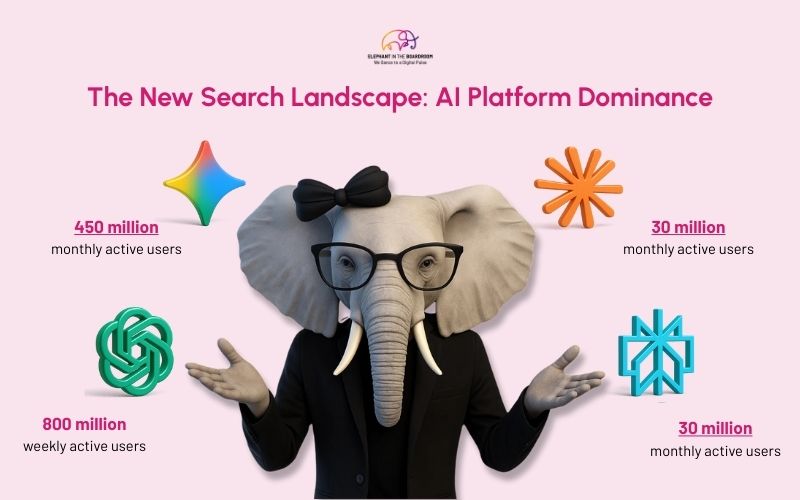
AI-powered answer engines are transforming how people find and consume information. Platforms like ChatGPT, Gemini, Claude 3.5, and Perplexity AI are no longer just tools—they are the next evolution of search, delivering precise answers instead of lists of links.
The numbers show their dominance:
- ChatGPT reaches 800 million weekly active users, making it one of the most frequently engaged AI systems globally.
- Gemini has climbed to over 450 million monthly active users, carving a significant space in the AI ecosystem.
- Claude 3.5 serves more than 30 million monthly users worldwide, reflecting a growing appetite for conversational intelligence.
- Perplexity AI also boasts roughly 30 million monthly users, demonstrating that niche platforms are still capturing meaningful engagement.
This rise of AI platforms has clear implications for content strategy:
- Platform-specific optimisation is critical- Each answer engine interprets and presents content differently.
- User intent is everything- Content must directly satisfy queries to be cited or recommended.
- Trust drives visibility- Accuracy, authority, and clarity determine whether an answer engine features your content.
In 2026, the brands that thrive will be those that understand these platforms at a granular level and craft content that isn’t just found, but actively recommended.
SEO in 2026: Optimising for Answer Engines in an AI-First World
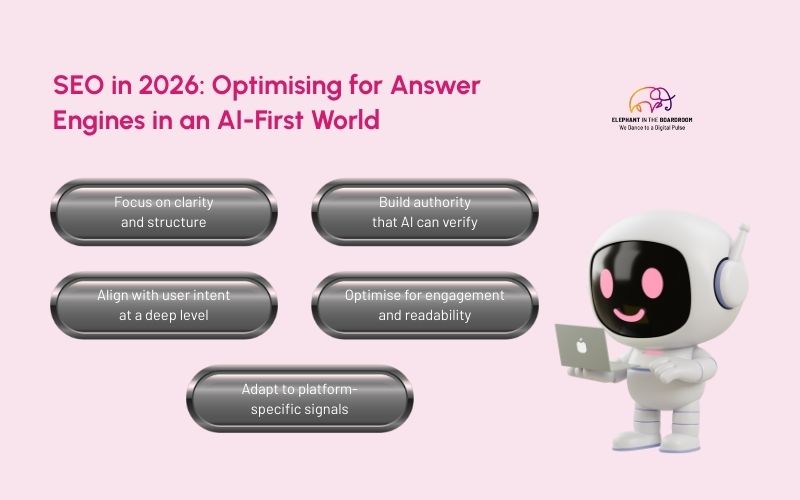
Some pages exist. Others get elevated. In 2026, the difference is whether AI considers your content the go-to answer. Here’s how you can optimise answer engines in an AI-first world to become that page:
Focus on Clarity and Structure
AI engines favour content they can easily understand and reference. Use clear headings, bullet points, numbered lists, and structured data. Well-organised content signals to AI that your page is a reliable, complete source of information, improving the likelihood of being cited or suggested.
Build Authority That AI Can Verify
SEO in 2026 rewards trust. Incorporate accurate data, expert insights, and credible references. Demonstrating knowledge and authority isn’t optional; it directly affects whether AI systems treat your content as a source worth recommending.
Align with User Intent at a Deep Level
Modern users ask precise, complex questions. Optimising for AI means delivering answers that satisfy these queries fully. Analyse the questions your audience is likely to ask and create content that addresses them comprehensively. AI engines favour content that anticipates follow-up questions and provides complete, actionable answers.
Optimise for Engagement and Readability
Even in an AI-first world, humans still interact with your content. SEO in 2026 works best when your content is digestible, visually organised, and easy to navigate. Short paragraphs, concise sentences, and clear explanations improve both user satisfaction and AI recommendation signals.
Adapt to Platform-Specific Signals
Different AI systems have different preferences. Some prioritise freshness, others favour depth or authority. Tailoring your content to the nuances of each platform ensures it performs optimally across multiple AI channels.
SEO in 2026: Take Control of Your AI-First Digital Future
As global experts in AI-first digital, we bring together website design, development, and marketing into one seamless strategy that positions your brand at the centre of the conversation. Every piece of content, every interaction, every click is designed to make your brand the authority people and AI trust.
Working with Elephant in the Boardroom means unlocking a partner who doesn’t just follow trends but anticipates them. We turn complexity into opportunity, helping you dominate search, capture attention, and create experiences that inspire action. Contact us and take the lead in the AI-first era.
Is traditional SEO dead because of AI? Not yet, but SEO in 2026 looks nothing like it did even a few years ago. The tactics that once guaranteed visibility are losing their power. Intelligent systems now decide what counts, rewarding clarity, authority, and content that actually answers questions. Brands stuck in the past risk fading into digital irrelevance, while those who adapt will see their content not just rank, but get cited and trusted by the AI engines shaping every user decision.
Businesses now have to think like AI, anticipating the questions users will ask and structuring content so it becomes the answer these systems rely on. Success isn’t measured in clicks or impressions anymore; it’s measured in relevance, authority, and the ability to be the content that AI chooses to recommend.
Keep reading to see how forward-thinking brands are rewriting their strategies, creating content designed to be indispensable, and taking control in a world where being the answer is the ultimate advantage.
What’s Inside:
- The New Search Landscape: AI Platform Dominance
- SEO in 2026: Optimising for Answer Engines in an AI-First World
- SEO in 2026: Take Control of Your AI-First Digital Future
The New Search Landscape: AI Platform Dominance
AI-powered answer engines are transforming how people find and consume information. Platforms like ChatGPT, Gemini, Claude 3.5, and Perplexity AI are no longer just tools—they are the next evolution of search, delivering precise answers instead of lists of links.
The numbers show their dominance:
- ChatGPT reaches 800 million weekly active users, making it one of the most frequently engaged AI systems globally.
- Gemini has climbed to over 450 million monthly active users, carving a significant space in the AI ecosystem.
- Claude 3.5 serves more than 30 million monthly users worldwide, reflecting a growing appetite for conversational intelligence.
- Perplexity AI also boasts roughly 30 million monthly users, demonstrating that niche platforms are still capturing meaningful engagement.
This rise of AI platforms has clear implications for content strategy:
- Platform-specific optimisation is critical- Each answer engine interprets and presents content differently.
- User intent is everything- Content must directly satisfy queries to be cited or recommended.
- Trust drives visibility- Accuracy, authority, and clarity determine whether an answer engine features your content.
In 2026, the brands that thrive will be those that understand these platforms at a granular level and craft content that isn’t just found, but actively recommended.
SEO in 2026: Optimising for Answer Engines in an AI-First World
Some pages exist. Others get elevated. In 2026, the difference is whether AI considers your content the go-to answer. Here’s how you can optimise answer engines in an AI-first world to become that page:
Focus on Clarity and Structure
AI engines favour content they can easily understand and reference. Use clear headings, bullet points, numbered lists, and structured data. Well-organised content signals to AI that your page is a reliable, complete source of information, improving the likelihood of being cited or suggested.
Build Authority That AI Can Verify
SEO in 2026 rewards trust. Incorporate accurate data, expert insights, and credible references. Demonstrating knowledge and authority isn’t optional; it directly affects whether AI systems treat your content as a source worth recommending.
Align with User Intent at a Deep Level
Modern users ask precise, complex questions. Optimising for AI means delivering answers that satisfy these queries fully. Analyse the questions your audience is likely to ask and create content that addresses them comprehensively. AI engines favour content that anticipates follow-up questions and provides complete, actionable answers.
Optimise for Engagement and Readability
Even in an AI-first world, humans still interact with your content. SEO in 2026 works best when your content is digestible, visually organised, and easy to navigate. Short paragraphs, concise sentences, and clear explanations improve both user satisfaction and AI recommendation signals.
Adapt to Platform-Specific Signals
Different AI systems have different preferences. Some prioritise freshness, others favour depth or authority. Tailoring your content to the nuances of each platform ensures it performs optimally across multiple AI channels.
SEO in 2026: Take Control of Your AI-First Digital Future
As global experts in AI-first digital, we bring together website design, development, and marketing into one seamless strategy that positions your brand at the centre of the conversation. Every piece of content, every interaction, every click is designed to make your brand the authority people and AI trust.
Working with Elephant in the Boardroom means unlocking a partner who doesn’t just follow trends but anticipates them. We turn complexity into opportunity, helping you dominate search, capture attention, and create experiences that inspire action. Contact us and take the lead in the AI-first era.
Is traditional SEO dead because of AI? Not yet, but SEO in 2026 looks nothing like it did even a few years ago. The tactics that once guaranteed visibility are losing their power. Intelligent systems now decide what counts, rewarding clarity, authority, and content that actually answers questions. Brands stuck in the past risk fading into digital irrelevance, while those who adapt will see their content not just rank, but get cited and trusted by the AI engines shaping every user decision.
Businesses now have to think like AI, anticipating the questions users will ask and structuring content so it becomes the answer these systems rely on. Success isn’t measured in clicks or impressions anymore; it’s measured in relevance, authority, and the ability to be the content that AI chooses to recommend.
Keep reading to see how forward-thinking brands are rewriting their strategies, creating content designed to be indispensable, and taking control in a world where being the answer is the ultimate advantage.
What’s Inside:
- The New Search Landscape: AI Platform Dominance
- SEO in 2026: Optimising for Answer Engines in an AI-First World
- SEO in 2026: Take Control of Your AI-First Digital Future
The New Search Landscape: AI Platform Dominance
AI-powered answer engines are transforming how people find and consume information. Platforms like ChatGPT, Gemini, Claude 3.5, and Perplexity AI are no longer just tools—they are the next evolution of search, delivering precise answers instead of lists of links.
The numbers show their dominance:
- ChatGPT reaches 800 million weekly active users, making it one of the most frequently engaged AI systems globally.
- Gemini has climbed to over 450 million monthly active users, carving a significant space in the AI ecosystem.
- Claude 3.5 serves more than 30 million monthly users worldwide, reflecting a growing appetite for conversational intelligence.
- Perplexity AI also boasts roughly 30 million monthly users, demonstrating that niche platforms are still capturing meaningful engagement.
This rise of AI platforms has clear implications for content strategy:
- Platform-specific optimisation is critical- Each answer engine interprets and presents content differently.
- User intent is everything- Content must directly satisfy queries to be cited or recommended.
- Trust drives visibility- Accuracy, authority, and clarity determine whether an answer engine features your content.
In 2026, the brands that thrive will be those that understand these platforms at a granular level and craft content that isn’t just found, but actively recommended.
SEO in 2026: Optimising for Answer Engines in an AI-First World
Some pages exist. Others get elevated. In 2026, the difference is whether AI considers your content the go-to answer. Here’s how you can optimise answer engines in an AI-first world to become that page:
Focus on Clarity and Structure
AI engines favour content they can easily understand and reference. Use clear headings, bullet points, numbered lists, and structured data. Well-organised content signals to AI that your page is a reliable, complete source of information, improving the likelihood of being cited or suggested.
Build Authority That AI Can Verify
SEO in 2026 rewards trust. Incorporate accurate data, expert insights, and credible references. Demonstrating knowledge and authority isn’t optional; it directly affects whether AI systems treat your content as a source worth recommending.
Align with User Intent at a Deep Level
Modern users ask precise, complex questions. Optimising for AI means delivering answers that satisfy these queries fully. Analyse the questions your audience is likely to ask and create content that addresses them comprehensively. AI engines favour content that anticipates follow-up questions and provides complete, actionable answers.
Optimise for Engagement and Readability
Even in an AI-first world, humans still interact with your content. SEO in 2026 works best when your content is digestible, visually organised, and easy to navigate. Short paragraphs, concise sentences, and clear explanations improve both user satisfaction and AI recommendation signals.
Adapt to Platform-Specific Signals
Different AI systems have different preferences. Some prioritise freshness, others favour depth or authority. Tailoring your content to the nuances of each platform ensures it performs optimally across multiple AI channels.
SEO in 2026: Take Control of Your AI-First Digital Future
As global experts in AI-first digital, we bring together website design, development, and marketing into one seamless strategy that positions your brand at the centre of the conversation. Every piece of content, every interaction, every click is designed to make your brand the authority people and AI trust.
Working with Elephant in the Boardroom means unlocking a partner who doesn’t just follow trends but anticipates them. We turn complexity into opportunity, helping you dominate search, capture attention, and create experiences that inspire action. Contact us and take the lead in the AI-first era.
Is traditional SEO dead because of AI? Not yet, but SEO in 2026 looks nothing like it did even a few years ago. The tactics that once guaranteed visibility are losing their power. Intelligent systems now decide what counts, rewarding clarity, authority, and content that actually answers questions. Brands stuck in the past risk fading into digital irrelevance, while those who adapt will see their content not just rank, but get cited and trusted by the AI engines shaping every user decision.
Businesses now have to think like AI, anticipating the questions users will ask and structuring content so it becomes the answer these systems rely on. Success isn’t measured in clicks or impressions anymore; it’s measured in relevance, authority, and the ability to be the content that AI chooses to recommend.
Keep reading to see how forward-thinking brands are rewriting their strategies, creating content designed to be indispensable, and taking control in a world where being the answer is the ultimate advantage.
What’s Inside:
- The New Search Landscape: AI Platform Dominance
- SEO in 2026: Optimising for Answer Engines in an AI-First World
- SEO in 2026: Take Control of Your AI-First Digital Future
The New Search Landscape: AI Platform Dominance
AI-powered answer engines are transforming how people find and consume information. Platforms like ChatGPT, Gemini, Claude 3.5, and Perplexity AI are no longer just tools—they are the next evolution of search, delivering precise answers instead of lists of links.
The numbers show their dominance:
- ChatGPT reaches 800 million weekly active users, making it one of the most frequently engaged AI systems globally.
- Gemini has climbed to over 450 million monthly active users, carving a significant space in the AI ecosystem.
- Claude 3.5 serves more than 30 million monthly users worldwide, reflecting a growing appetite for conversational intelligence.
- Perplexity AI also boasts roughly 30 million monthly users, demonstrating that niche platforms are still capturing meaningful engagement.
This rise of AI platforms has clear implications for content strategy:
- Platform-specific optimisation is critical- Each answer engine interprets and presents content differently.
- User intent is everything- Content must directly satisfy queries to be cited or recommended.
- Trust drives visibility- Accuracy, authority, and clarity determine whether an answer engine features your content.
In 2026, the brands that thrive will be those that understand these platforms at a granular level and craft content that isn’t just found, but actively recommended.
SEO in 2026: Optimising for Answer Engines in an AI-First World
Some pages exist. Others get elevated. In 2026, the difference is whether AI considers your content the go-to answer. Here’s how you can optimise answer engines in an AI-first world to become that page:
Focus on Clarity and Structure
AI engines favour content they can easily understand and reference. Use clear headings, bullet points, numbered lists, and structured data. Well-organised content signals to AI that your page is a reliable, complete source of information, improving the likelihood of being cited or suggested.
Build Authority That AI Can Verify
SEO in 2026 rewards trust. Incorporate accurate data, expert insights, and credible references. Demonstrating knowledge and authority isn’t optional; it directly affects whether AI systems treat your content as a source worth recommending.
Align with User Intent at a Deep Level
Modern users ask precise, complex questions. Optimising for AI means delivering answers that satisfy these queries fully. Analyse the questions your audience is likely to ask and create content that addresses them comprehensively. AI engines favour content that anticipates follow-up questions and provides complete, actionable answers.
Optimise for Engagement and Readability
Even in an AI-first world, humans still interact with your content. SEO in 2026 works best when your content is digestible, visually organised, and easy to navigate. Short paragraphs, concise sentences, and clear explanations improve both user satisfaction and AI recommendation signals.
Adapt to Platform-Specific Signals
Different AI systems have different preferences. Some prioritise freshness, others favour depth or authority. Tailoring your content to the nuances of each platform ensures it performs optimally across multiple AI channels.
SEO in 2026: Take Control of Your AI-First Digital Future
As global experts in AI-first digital, we bring together website design, development, and marketing into one seamless strategy that positions your brand at the centre of the conversation. Every piece of content, every interaction, every click is designed to make your brand the authority people and AI trust.
Working with Elephant in the Boardroom means unlocking a partner who doesn’t just follow trends but anticipates them. We turn complexity into opportunity, helping you dominate search, capture attention, and create experiences that inspire action. Contact us and take the lead in the AI-first era.







4.4 rating from 30 Google reviews